
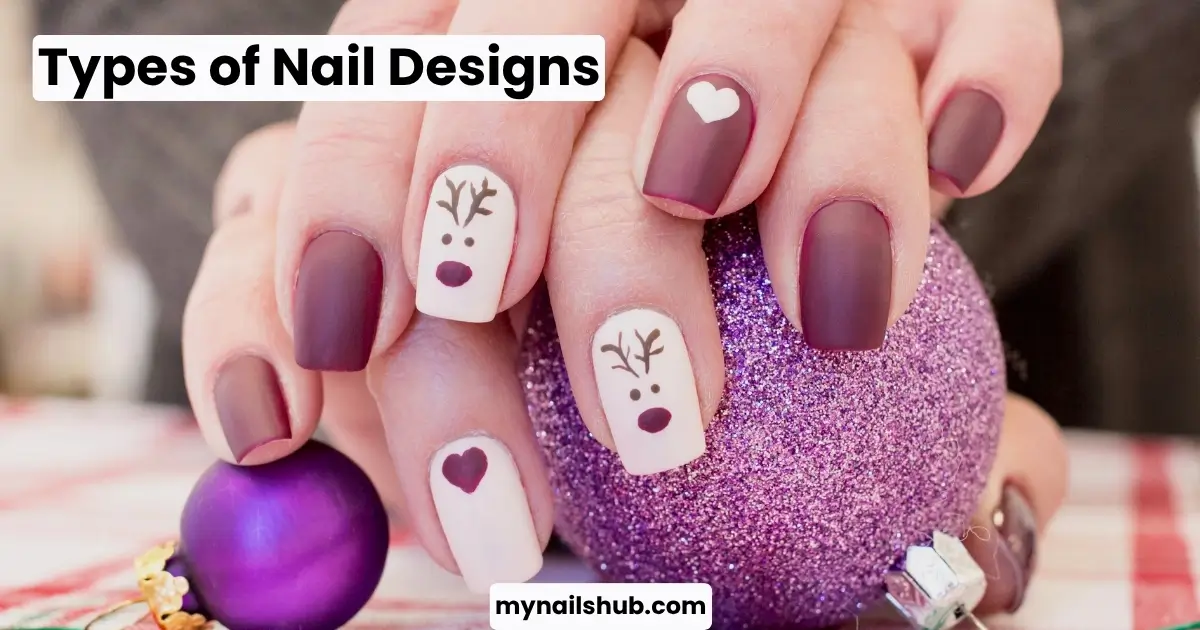
30+ Types of Nail Designs and Nail Art Styles
From French tips and chrome to abstract lines, florals, negative space, marble, 3D art, and magnetic finishes, here is a practical guide to the different types of nail designs you can choose for your next manicure.
If you have ever sat in a nail salon and thought, “I know I want nail art, but I have no idea what this style is called,” you are not alone.
Nail art has developed its own vocabulary. Some names describe the technique. Others describe the finish, the placement, the pattern, or the overall aesthetic.
That distinction matters when you are looking for inspiration or explaining a manicure to a nail artist.
For example, chrome describes a finish. French describes a placement style. Floral describes the artwork itself. Negative space describes how much of the natural nail remains visible.
Once you understand those categories, choosing a manicure becomes much easier.
If you are looking for broader inspiration after learning about different styles, explore these nail design ideas to see how different techniques can come together in a finished manicure.
What Are the Classic Types of Nail Designs?
Some nail styles have stayed popular because they are easy to adapt. They can work for everyday manicures, special events, and different nail lengths.
French Nail Designs
French nails use a contrasting tip over a different base. The classic version pairs a light base with a white tip, but modern versions can use almost any color combination.
Micro French, double French, colored French, reverse French, and diagonal French are all ways to change the basic idea without losing its recognizable structure.
Solid Color Nails
A solid manicure is one of the simplest nail design types. The entire nail uses one main color with little or no artwork.
The simplicity makes the finish especially important. Glossy, matte, shimmer, metallic, and jelly effects can completely change the mood without adding painted artwork.
Ombre Nail Designs
Ombre nails blend one color into another rather than creating a hard line between shades.
The gradient can move from light to dark, one color family to another, or a sheer base into a brighter tip.
Half-Moon Nail Designs
Half-moon designs create a curved section near the base of the nail. The shape can be left natural or filled with another color.
It is a useful option when you want something more distinctive than solid polish without covering the entire nail with artwork.
Some designs focus on texture as much as color and pattern. These raised nail designs are a good example of how dimensional details can change the look of a manicure.
What Types of Nail Designs Are Based on the Finish?
A finish changes how the surface catches light. You can use the same base color with different finishes and get completely different results.
Chrome Nails
Chrome nails have a reflective metallic appearance. The effect can range from silver mirror chrome to colorful, pearly, holographic, or glazed variations.
Chrome also works as an accent. You can use it across the full nail, on a French tip, or over selected sections of artwork.
Glazed Nail Designs
Glazed nails create a soft, luminous surface. The effect usually looks more subtle than a strong mirror chrome.
This style works especially well when you want shine without a highly graphic manicure.
Matte Nail Designs
Matte nails remove the traditional glossy reflection from the surface. This can make colors look softer, flatter, or more editorial.
Matte also creates useful contrast when combined with glossy details, metallic accents, or glossy French tips.
Velvet Nail Designs
Velvet nails use a magnetic shimmer effect to create a soft, dimensional glow that shifts as the light moves across the nail.
The finish can look understated in low light and much more dramatic under direct lighting.
Cat-Eye Nails
Cat-eye nails use magnetic particles to create a concentrated streak of reflected light across the nail.
The direction of that highlight can change the appearance of the manicure, making the same polish look different from different angles.
Metallic Nail Designs
Metallic nails use reflective colors such as silver, gold, bronze, copper, or other metallic shades.
Metallic polish can be the entire manicure or a small detail inside French tips, graphic lines, or abstract artwork.
Glitter Nail Designs
Glitter nails add visible sparkle through glitter polish, loose glitter, flakes, or glitter accents.
Full glitter creates a statement manicure. Glitter tips or accent nails give you a more controlled version.
Jelly Nail Designs
Jelly nails have a translucent appearance. The color remains visible while some light passes through the nail.
They work particularly well with layered artwork because the transparency can become part of the design.
What Are the Main Types of Painted Nail Art?
Painted nail art is where the artwork itself becomes the main feature. This category includes recognizable motifs as well as freeform designs.
Floral Nail Designs
Floral nails use flowers, petals, leaves, vines, or botanical details. They can be tiny and delicate or large enough to dominate the nail.
Floral artwork works across many aesthetics, from soft romantic manicures to colorful summer sets.
Abstract Nail Designs
Abstract nails use shapes, curves, brushstrokes, lines, and unexpected color combinations without following one literal subject.
The freedom is the point. Each nail can look different while the color palette keeps the complete manicure connected.
Animal Print Nails
Animal print designs borrow recognizable patterns from leopard, zebra, cow, snake, tortoiseshell, and other animal-inspired textures.
You can keep the colors realistic or turn the pattern into something more graphic with unexpected shades.
Marble Nail Designs
Marble nails imitate the natural movement of stone through layered colors and irregular veins.
White and gray are classic choices, but colorful marble can create completely different moods.
Watercolor Nail Art
Watercolor-inspired nails use soft, translucent color transitions. The result looks lighter and less defined than traditional solid artwork.
It is especially effective for florals, abstract washes, and dreamy color combinations.
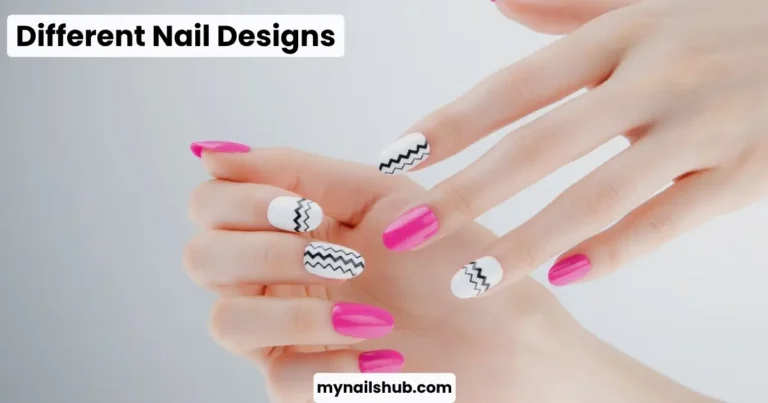
If you want to create a manicure where every finger has a different look, these different nail designs can give you plenty of ideas for mixing styles within one set.
What Are Graphic Types of Nail Designs?
Graphic nail art relies on structure. Instead of looking like a painted picture, it often uses lines, shapes, contrast, and repeated patterns.
Geometric Nail Designs
Geometric nails use triangles, squares, circles, grids, diagonal sections, and other structured shapes.
They look especially strong when the color palette stays controlled.
Color-Block Nail Designs
Color blocking divides the nail into clear areas of contrasting or complementary color.
Straight lines can make the design feel architectural, while curved sections create a softer interpretation.
Line Art Nails
Line-art nails use thin lines to create faces, flowers, abstract shapes, silhouettes, or simple graphic compositions.
Because the artwork is often delicate, negative space becomes an important part of the final design.
Checkerboard Nail Designs
Checkerboard nails use repeated squares to create a high-contrast pattern.
Black and white is the obvious combination, but softer colors can make the same pattern much easier to wear every day.
Swirl Nail Designs
Swirl nails use curved lines that move across the nail. The lines can be thin, bold, colorful, or layered.
Swirls are one of the easiest ways to make a simple manicure feel more artistic without covering the entire nail.
What Types of Nail Designs Add Texture or Dimension?
Not every nail design is flat. Some styles intentionally rise above the nail surface or add physical materials.
3D Nail Designs
3D nails add raised elements to the manicure. These can include sculpted flowers, bows, shapes, charms, or other dimensional details.
The extra height makes these designs more noticeable, so they are often used as statement or event manicures.
Rhinestone Nail Designs
Rhinestone nails use crystals or stones to create sparkle and dimension.
A few stones can create a subtle accent. Dense placement creates a much more dramatic look.
Charm Nail Designs
Charm nails use small decorative pieces attached to the nail surface. Hearts, bows, stars, pearls, metallic shapes, and other motifs can become focal points.
Charms work particularly well when the rest of the manicure is kept relatively simple.
Pearl Nail Designs
Pearl nails use individual pearls or pearl-like details to create a soft, dimensional finish.
They can work beautifully with bridal, romantic, minimalist, or elegant manicure concepts.
What Nail Designs Are Based on Placement?
Some styles are defined less by the artwork itself and more by where the artwork sits on the nail.
Negative Space Nails
Negative space designs intentionally leave parts of the natural nail visible.
The bare area becomes part of the composition rather than simply an empty section.
Accent Nail Designs
Accent nails give one or two fingers a different design from the rest of the manicure.
This is useful when you want detailed artwork without committing to an intricate design on all ten nails.
Reverse French Nails
Reverse French designs move the contrasting section toward the base of the nail rather than placing it only at the tip.
It gives the familiar French structure a different visual direction.
Double French Nails
Double French nails use two contrasting lines or bands instead of one traditional tip.
The extra line can be subtle or colorful depending on the overall manicure.
What Are the Different Nail Art Application Types?
Another way to classify nail art is by how the design gets onto the nail. This is particularly useful for beginners deciding what technique they want to try.
| Application type | How it works | Best suited for |
|---|---|---|
| Freehand | The design is painted directly onto the nail. | Custom artwork and personal designs. |
| Stamping | A prepared pattern is transferred onto the nail. | Detailed repeating patterns. |
| Nail stickers | Pre-made adhesive artwork is placed on the nail. | Quick designs and beginners. |
| Decals | Printed artwork is transferred onto the nail. | Detailed images and motifs. |
| Airbrush | Color is sprayed through an airbrush system. | Gradients and soft effects. |
| Encapsulation | Decorative elements are placed within a nail enhancement. | Layered and dimensional effects. |
The technique you choose can change both the appearance and the amount of control you have. Freehand painting gives the artist flexibility, while stamping can make repeated patterns more consistent.
What Is the Difference Between Nail Design and Nail Art?
The terms overlap, but they can describe slightly different ideas.
Nail art usually refers to the decorative artwork itself, such as flowers, lines, characters, patterns, or abstract shapes.
Nail design can describe the complete visual concept, including the base color, nail shape, finish, artwork, placement, and overall composition.
Are Nail Shapes the Same as Nail Design Types?
No. This is one of the most common points of confusion.
Almond, square, oval, coffin, stiletto, squoval, and other terms describe the shape of the nail.
French, chrome, marble, floral, abstract, negative space, and 3D describe the design or decorative treatment.
Once you separate these categories, you can combine them much more easily. For example, you could have medium almond nails with a chrome French design and a glossy finish.
How Do You Choose the Right Type of Nail Design?
Start with your lifestyle instead of starting with the trend.
A dramatic 3D manicure might be perfect for a special event but inconvenient if you spend your day typing, working with your hands, or wearing gloves.
Your nail length matters too. A detailed design needs enough surface area to remain readable. Short nails often look strongest when the artwork is simplified.
Can You Combine Different Types of Nail Designs?
Absolutely. In fact, some of the most interesting manicures combine several categories.
You could pair a French tip with chrome. You could add floral artwork over a jelly base. You could combine negative space with geometric lines. You could even use a matte base with glossy artwork.
The trick is giving every style a reason to be there.
Keep at least one visual element consistent. Use the same color family, repeat one pattern, or give every nail the same finish.
What Nail Design Types Are Easiest for Beginners?
Beginners usually do better with designs that rely on simple shapes and controlled placement.
- Solid color nails
- Simple French tips
- Dot designs
- Minimal line art
- Simple glitter accents
- Basic negative space designs
- Easy floral dots
- Simple color blocking
Start with one technique and repeat it. Once your control improves, combine two techniques in the same manicure.
Which Nail Design Types Need More Professional Skill?
Some designs are much less forgiving than others.
| Design type | Why it can be difficult |
|---|---|
| Intricate freehand | Requires consistent brush control and detailed linework. |
| 3D sculpted art | Requires material control and dimensional construction. |
| Detailed portraits | Small nail surfaces make proportion and detail difficult. |
| Complex chrome effects | The finish depends heavily on compatible products and technique. |
| Dense charm designs | Placement, balance, and secure attachment become important. |
| Intricate marble | Natural-looking veins require controlled irregularity. |
That does not mean beginners cannot try them. It simply means the learning curve is higher.
How Do You Describe a Nail Design to a Nail Tech?
Instead of saying only “I want pretty nails,” give your nail artist the design vocabulary that describes the actual look.
“I want medium almond nails with a soft pink base, a thin white French tip, and a chrome accent on two nails. I want the overall finish glossy and the artwork minimal.”
That sentence gives the nail tech several useful pieces of information: shape, length, base color, design type, accent placement, finish, and overall intensity.
You can also bring a reference photo. The best reference is one that closely matches the nail length and shape you plan to wear.
Which Nail Design Type Should You Try First?
If you are completely undecided, start with the category that matches your normal style.
What Is the Difference Between a Nail Trend and a Nail Design Type?
A design type describes what the manicure is. A trend describes what is becoming especially popular at a particular time.
French is a long-standing design type. A particular version of French can become trendy for a season.
Chrome is a finish category. A specific chrome color or combination can become a trend.
This distinction is useful because trends change quickly, while design categories give you a much larger vocabulary for finding the look you actually want.
Quick Reference: 30+ Types of Nail Designs
| # | Type | Main characteristic |
|---|---|---|
| 1 | French | Contrasting tip |
| 2 | Solid color | One main color |
| 3 | Ombre | Blended color transition |
| 4 | Half-moon | Curved base section |
| 5 | Chrome | Reflective metallic finish |
| 6 | Glazed | Luminous translucent shine |
| 7 | Matte | Low-reflection finish |
| 8 | Velvet | Magnetic dimensional shimmer |
| 9 | Cat-eye | Focused magnetic highlight |
| 10 | Metallic | Metal-like color effect |
| 11 | Glitter | Sparkling particles |
| 12 | Jelly | Translucent color |
| 13 | Floral | Flowers and botanical art |
| 14 | Abstract | Freeform shapes and lines |
| 15 | Animal print | Animal-inspired patterns |
| 16 | Marble | Stone-inspired veins |
| 17 | Watercolor | Soft translucent artwork |
| 18 | Geometric | Structured shapes |
| 19 | Color block | Divided color sections |
| 20 | Line art | Fine illustrative lines |
| 21 | Checkerboard | Repeated square pattern |
| 22 | Swirl | Curved flowing lines |
| 23 | 3D | Raised artwork |
| 24 | Rhinestone | Crystal embellishments |
| 25 | Charm | Attached decorative pieces |
| 26 | Pearl | Dimensional pearl details |
| 27 | Negative space | Visible natural nail |
| 28 | Accent nail | One or more different nails |
| 29 | Reverse French | French detail near the base |
| 30 | Double French | Two contrasting tip lines |
Frequently Asked Questions About Nail Design Types
What are the different types of nail designs?
What are the names of nail art styles?
What are the different kinds of nail art designs?
What is the most popular type of nail design?
What is the difference between nail art and nail design?
Are almond and coffin nail designs different styles?
What nail design is easiest for beginners?
What type of nail design looks best on short nails?
Can you combine different nail design types?
What should I tell my nail tech when choosing a design?
Final Thoughts
Once you understand the different types of nail designs, choosing a manicure becomes much less confusing.
You do not have to search for one perfect picture. Start by choosing the category you like. Then decide on the nail shape, color palette, finish, and level of detail.
Maybe you want a classic French. Maybe you prefer chrome and magnetic finishes. Or perhaps abstract lines, florals, marble, or 3D details feel more like you.
The best part is that these categories are not rigid. You can combine them to create something personal instead of copying one manicure exactly.
Nail design terminology can overlap because some names describe artwork, while others describe finishes, placement, materials, or nail shape. This guide separates those categories to make manicure planning easier.

6 Comments