Close your eyes for a second and imagine the sky just after sunrise, that soft, dreamy moment when pale lavender melts into blush pink, which fades into the softest gold, which dissolves into morning blue. It’s one of the most beautiful things in the world. Quiet, effortless, perfect.
Now imagine wearing that on your nails.
That’s exactly what pastel transition nails deliver, and if you haven’t tried this look yet, you’re genuinely missing one of the most beautiful nail trends of the moment. These gradient, blended, color-shifting nail ideas are having a serious season across the US, Canada, the UK, and Australia, showing up on everyone from nail artists to everyday people who just want something that feels fresh and a little magical.
And the best part? You don’t need to be a professional to pull them off. You need the right inspiration, a little technique, and this guide, which covers all 29 ideas from beginner-friendly basics to full multi-color masterpieces.
Let’s start blending.
What Pastel Transition Nails Actually Are
Before the ideas, a quick foundation, because “transition nails” means slightly different things depending on who you ask.
The Core Concept Explained
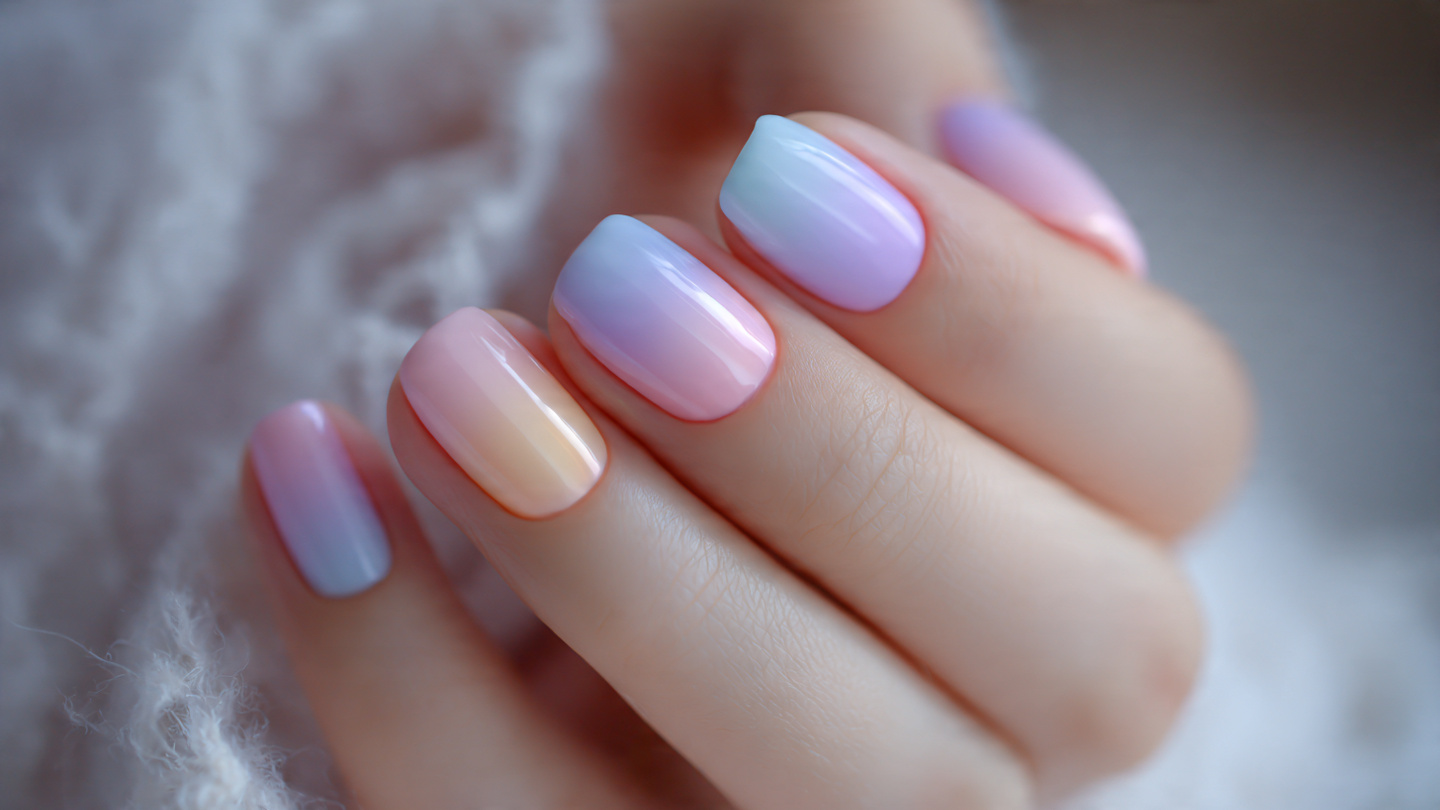
Pastel transition nails are any nail look where two or more soft, muted colors blend, fade, or shift into each other. This can happen within a single nail, like a lilac-to-mint ombré, or across a full set of nails, where each finger graduates through a spectrum of pastel shades. Some looks blend seamlessly with no visible line. Others create a soft, watercolor-like wash where colors meet. Both are beautiful. Both are “transition nails.”
Why This Trend Has Real Staying Power
Pastel transition nails sit at the intersection of wearable and artistic, which is exactly why they’ve stayed relevant across multiple seasons rather than flashing in and out like a typical trend. They’re sophisticated enough to feel intentional, soft enough to work in almost any context, and varied enough that you never run out of new combinations to try. They also photograph beautifully, which doesn’t hurt.
The 29 ideas below cover every style within this aesthetic, from single-nail gradients to full rainbow sets, from beginner sponge techniques to press-on shortcuts. There’s something here for every skill level and every nail length.
The Classic Single-Nail Gradient Looks
These are the foundation of the pastel transition world. One nail, two colors, one breathtaking blend.
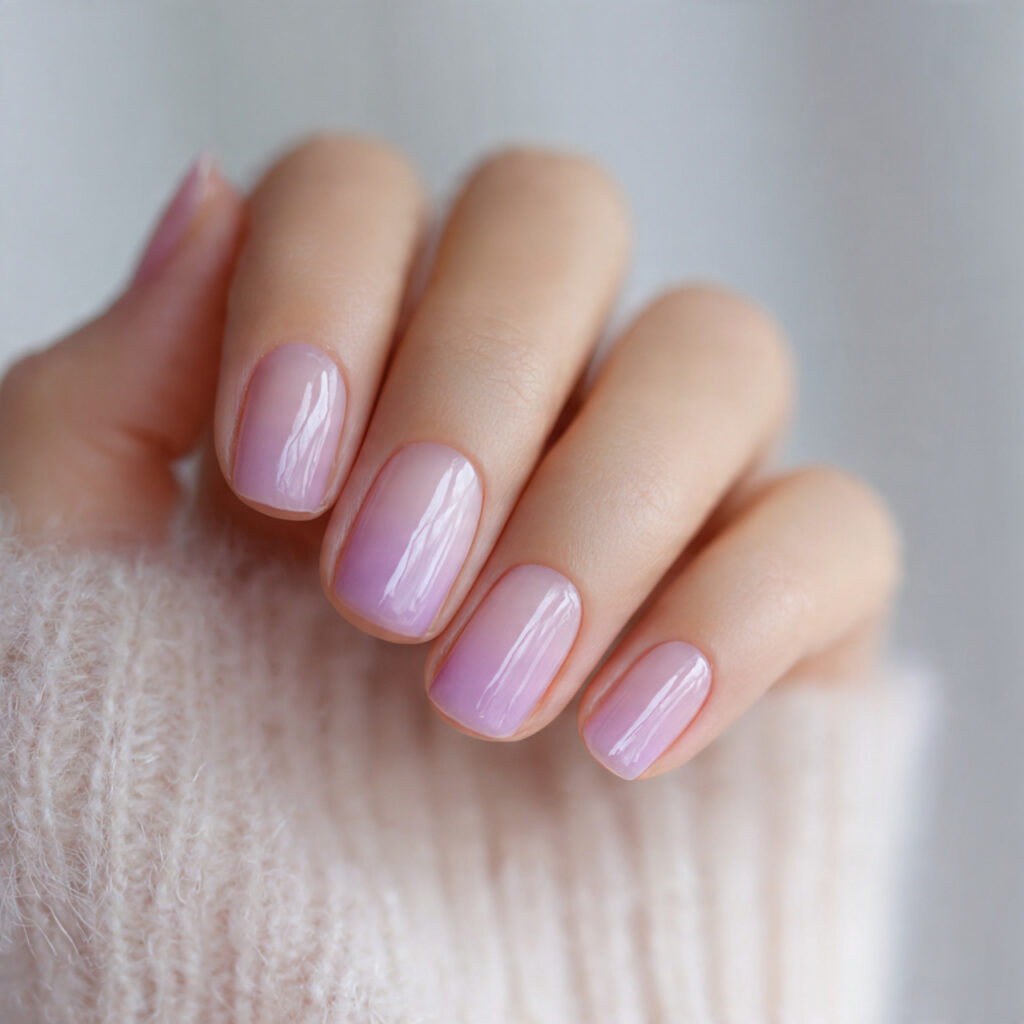
1. Lavender to Baby Pink
Why It Works
Lavender and baby pink sit close enough on the color wheel to blend harmoniously but are distinct enough to create visible, beautiful contrast. The transition between them has a romantic, almost dreamy quality, like the edge of a flower petal where two colors live simultaneously.
How to Do It
Apply lavender from the base up two-thirds of the nail. Apply baby pink from the tip down two-thirds. Where they meet in the middle, use a small makeup sponge to dab and blend in short, overlapping strokes until the line disappears. Seal with high-gloss top coat.
Common Mistake
Using shades that are too similar in depth, both too light or both too saturated. You want one shade to be slightly lighter or cooler than the other so the transition reads clearly. If everything blends to the same tone, the gradient disappears.
Also Read: 22 Soft Glam Nail Ideas That Look Elegant, Glossy & Totally Chic Don’t Miss These
2. Mint to Sky Blue

Why It Works
Cool-toned and clean, mint to sky blue feels fresh in every season. It’s the color combination of a perfect spring morning, light, clear, and quietly uplifting. On shorter nails it looks crisp. On longer nails it looks almost watercolor-painted.
How to Do It
Sponge technique works beautifully here. Paint both shades on a makeup sponge in overlapping strips, then dab the sponge onto the nail, moving slightly between applications to keep the blend even. Three to four sponge layers build the gradient beautifully.
Insider Tip
Mint-to-blue gradients look even more stunning over a sheer white base, which gives the colors something bright to reflect against. The result is more vivid than applying directly to a natural nail.
Read More: 27 Clean Nails Aesthetic Ideas That Feel Fresh, Polished & Perfect Try These Today
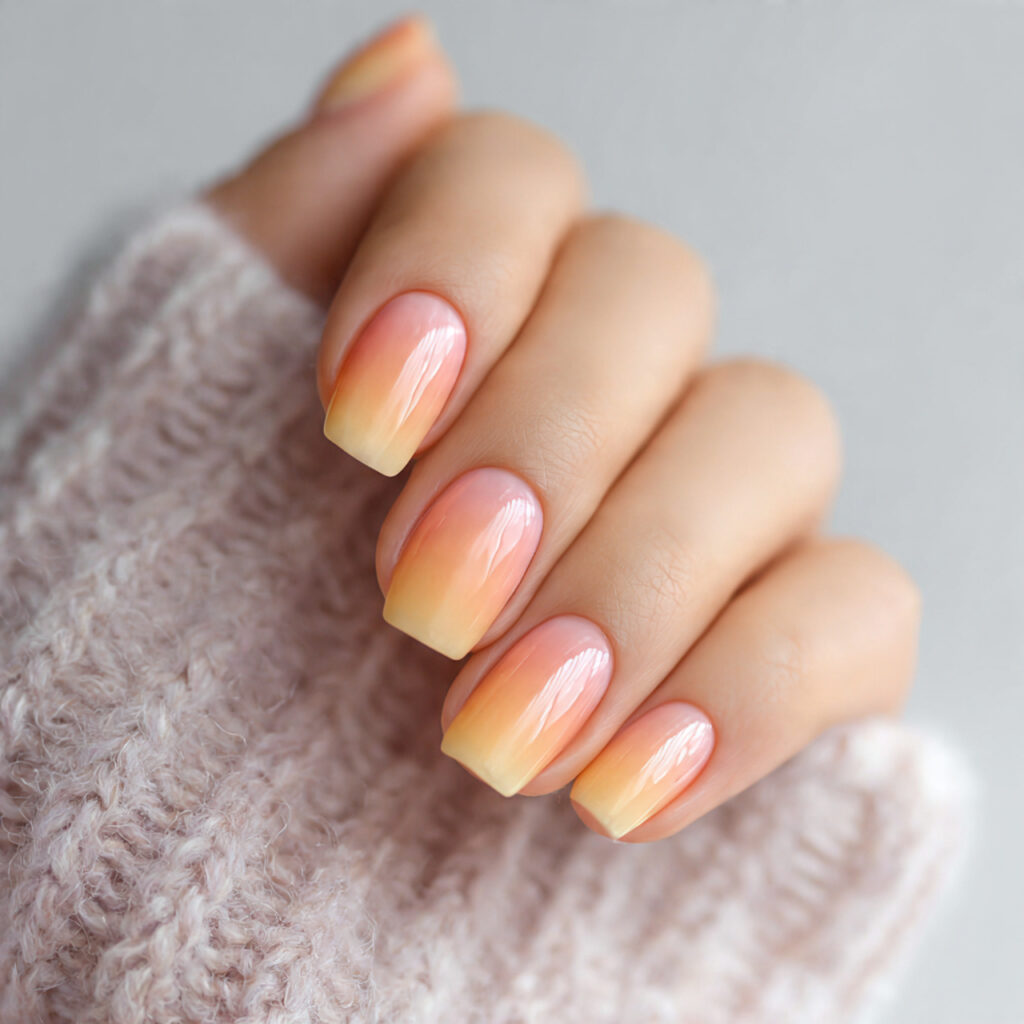
3. Peach to Soft Yellow
Why It Works
Warm pastels blending into each other carry a sunset energy that’s incredibly appealing. Peach fading to soft butter yellow looks like the last light of a summer afternoon, warm, gentle, and completely lovely. This combination is one of the most underrated in the pastel palette.
How to Do It
Apply peach from the base and soft yellow from the tip, blending at the center with a sponge. Because these shades are both warm-toned, they blend particularly easily without creating a muddy middle zone.
Common Mistake
Choosing a yellow that’s too bright or saturated. In pastel transition nails, the yellow should be pale and buttery, almost cream with just a whisper of yellow, so it blends softly rather than creating a harsh contrast.
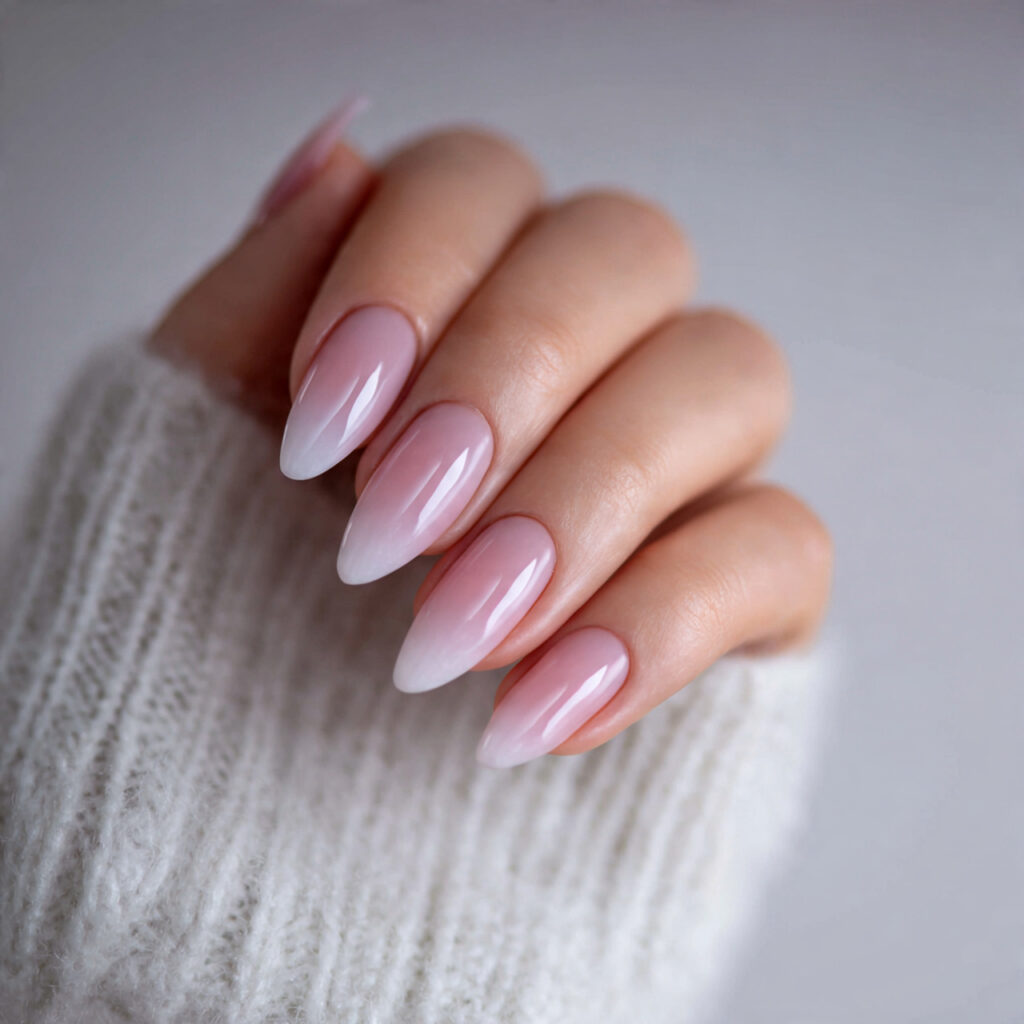
4. Blush Pink to Ivory White
Why It Works
Blush fading to white is the most wearable pastel transition look available. It reads as sophisticated and clean, appropriate for literally any setting, and yet still carries that beautiful color-shift quality that makes transition nails special. Think of it as the French manicure’s artistic, more romantic cousin.
How to Do It
Apply blush at the base and milky white at the tip, blending in the center. The key is keeping both shades sheer or semi-sheer so the transition feels ethereal rather than abrupt. A glossy top coat over this combination makes it look genuinely luminous.
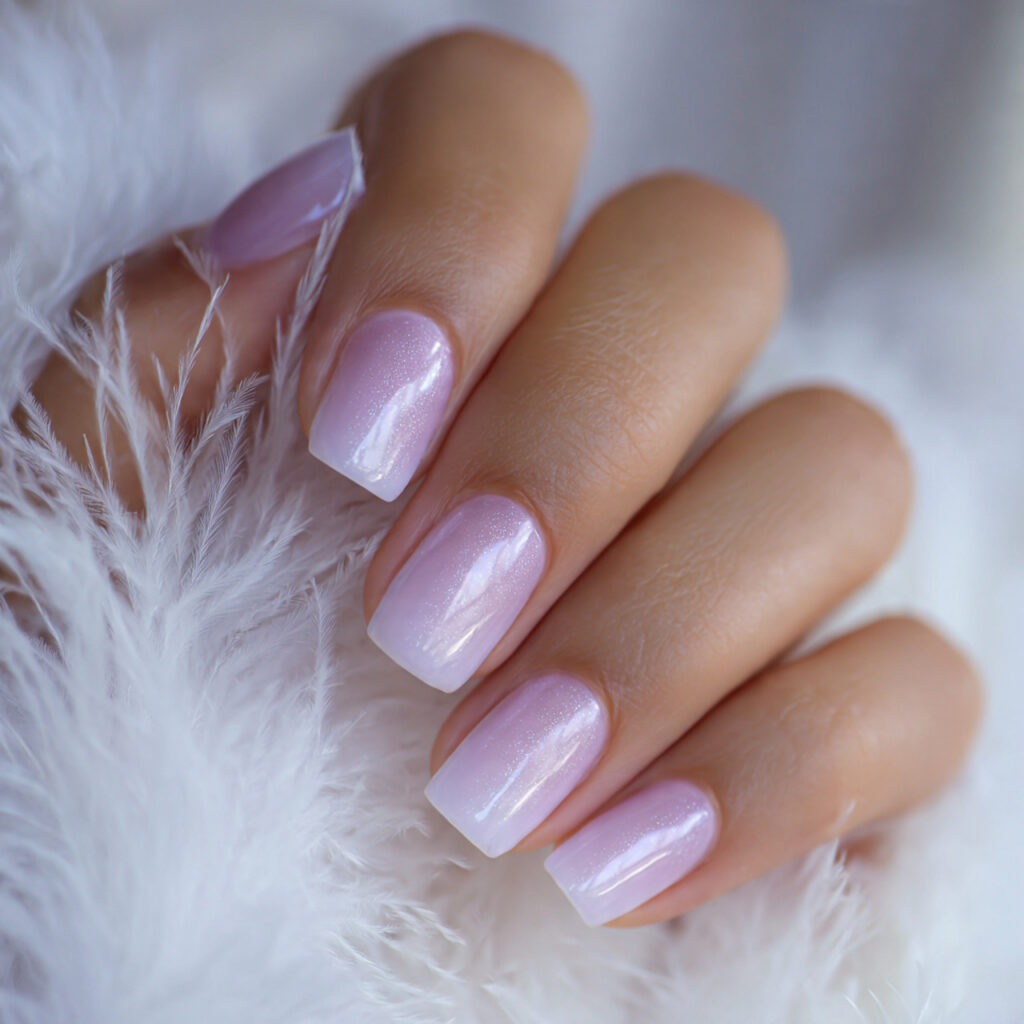
5. Lilac to Soft White
Why It Works
Lilac dissolving into white has an almost magical quality, like looking at something through soft fog. It’s delicate, feminine, and the kind of nail look that makes people do a double-take trying to figure out what color you’re wearing. The answer is: both, and neither, and somehow everything.
How to Do It
Use a fan brush rather than a sponge for this one, it creates a softer, more wispy blend that suits the ethereal quality of this color pairing. Feather the lilac up from the base and the white down from the tip until they whisper into each other.
Insider Tip
Finish with a pearl shimmer top coat over this combination. The iridescence adds another dimension to the fade that makes it look genuinely extraordinary.
These first five looks are the building blocks, and everything ahead uses them as a springboard for something even more beautiful. Keep reading.
Multi-Color Pastel Transition Looks
When one gradient isn’t enough, you go full spectrum. These multi-color looks are more complex but follow the same basic principles, and the results are breathtaking.
6. Rainbow Pastel Set

Why It Works
A full pastel rainbow across ten nails, each nail in a different pastel shade moving through the spectrum, is one of the most joyful, expressive nail looks imaginable. It’s colorful but soft, bold but gentle. The muted quality of pastels keeps a rainbow set from looking like a box of crayons and transforms it into something genuinely artful.
How to Do It
Assign each nail a position in the rainbow: soft red-coral, peach, butter yellow, mint, sky blue, soft periwinkle, lavender, and blush pink. Let each nail be a solid pastel, no gradient needed within each nail. The transition happens across the set rather than within individual nails.
Common Mistake
Choosing pastels that vary wildly in depth or saturation. For a cohesive rainbow set, all shades should feel equally soft and muted. If one nail looks significantly more saturated than the others, it breaks the dreamy uniformity.
7. Tri-Color Gradient on Each Nail
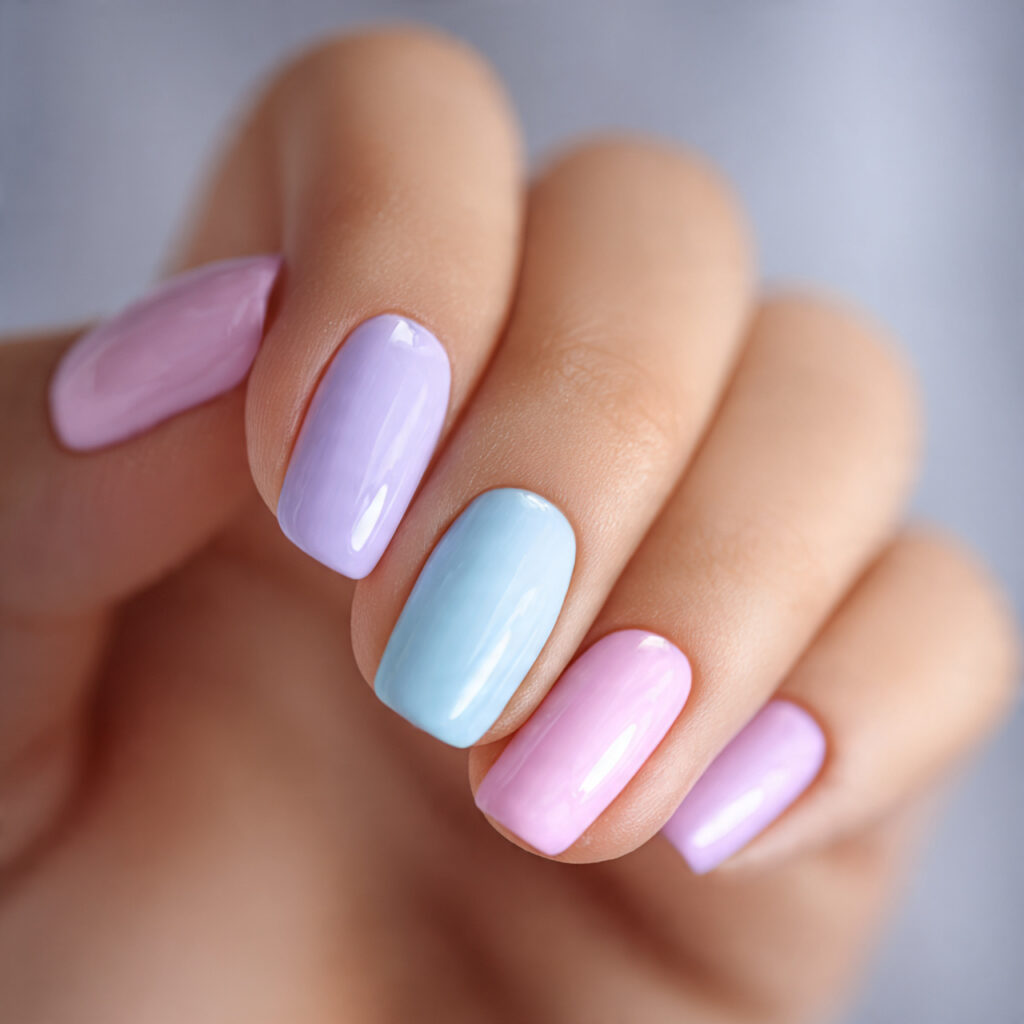
Why It Works
A three-color gradient on a single nail is the most dramatic version of the transition look — and in pastels, it’s surprisingly wearable because the softness of the shades keeps the effect from overwhelming. Lavender to blush to peach, for example, moves through an entire warm-cool spectrum on one nail beautifully.
How to Do It
Apply each color in roughly equal thirds of the nail, then blend each boundary with a sponge. The key is blending one transition fully before moving to the next so you don’t muddy all three shades together.
8. Alternating Gradient Set
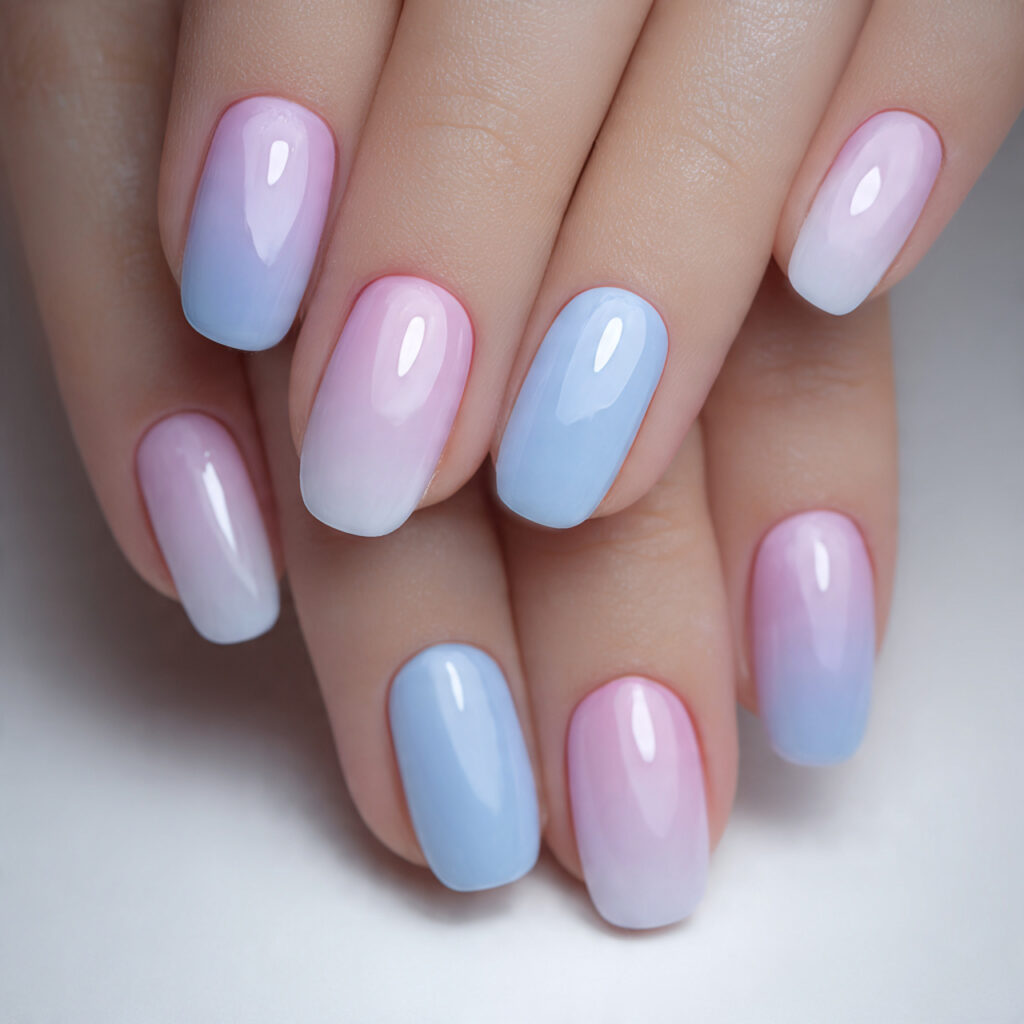
Why It Works
Rather than moving through a spectrum, an alternating set uses two pastel gradients that switch between fingers. Nails one, three, and five fade from lilac to mint. Nails two and four fade from blush to sky blue. The alternation creates rhythm and visual interest across the full set.
How to Do It
Decide on your two gradient combinations before starting. Apply one gradient to the alternating nails first, let dry completely, then apply the second. The contrast between the two color stories makes each individual nail stand out more than it would in a uniform set.
9. Diagonal Pastel Transition
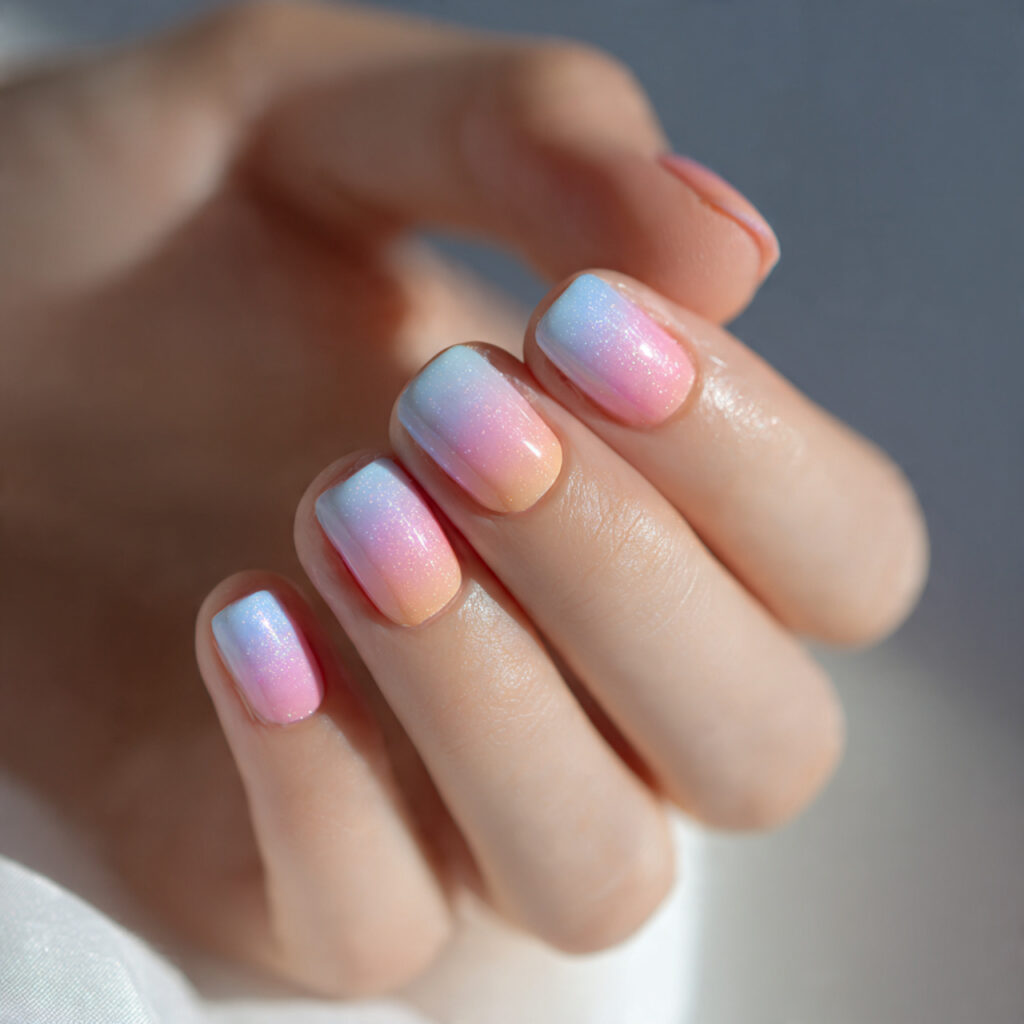
Why It Works
Most gradients move vertically, base to tip. A diagonal gradient moves corner to corner, which creates a completely different, more architectural effect. It looks simultaneously more artistic and more modern than a traditional vertical fade.
How to Do It
Apply your base color in one corner and your second color in the opposite corner. Use a sponge to blend diagonally across the nail. Nail tape applied diagonally can help you keep the boundaries defined if freehand feels intimidating.
Insider Tip
Diagonal gradients look particularly beautiful on longer, more rectangular nail shapes, coffin and soft squares especially, because the shape gives the diagonal more room to develop.
10. Pastel Ombré Across the Full Hand
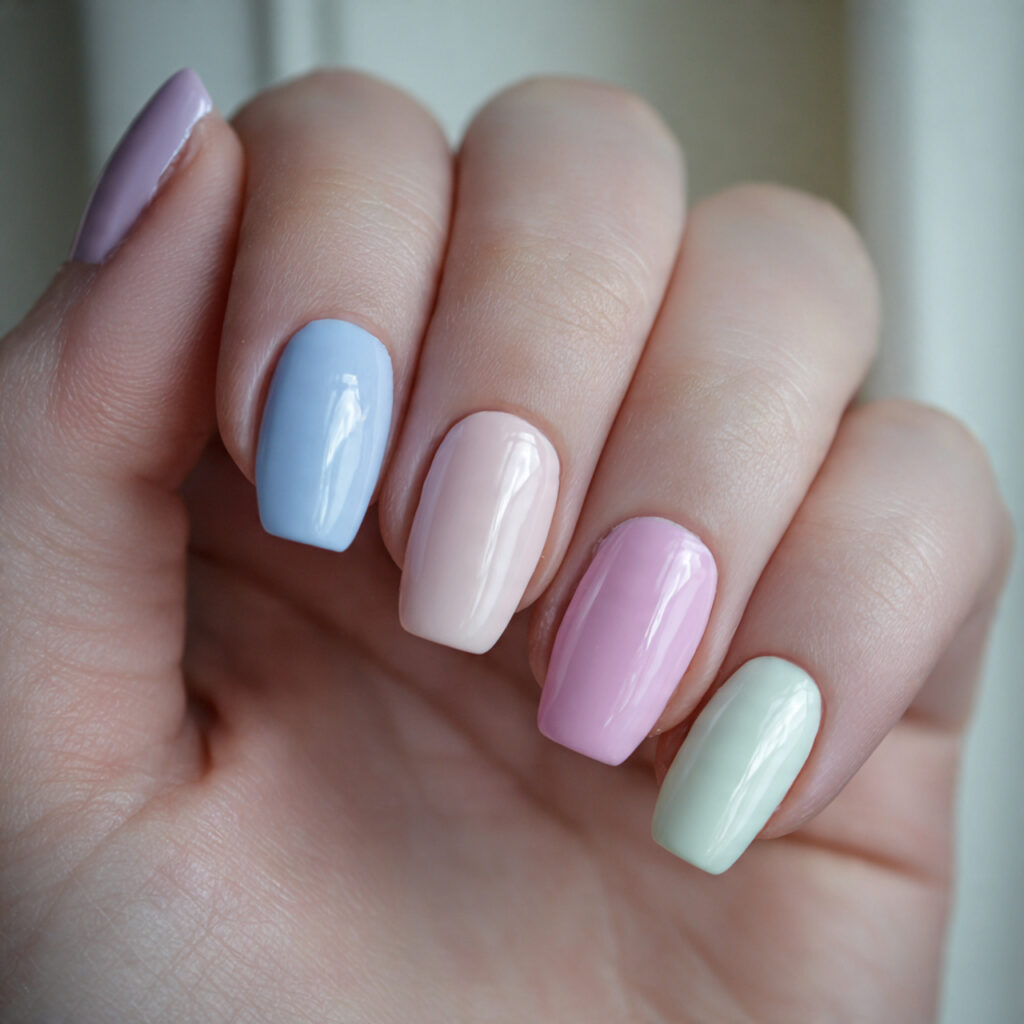
Why It Works
This is the most cohesive version of the transition nail concept. All five nails on one hand graduate through a continuous spectrum, the pinky in the palest shade, each finger getting very slightly deeper or more saturated, with the thumb in the richest version of the color. The effect is like a watercolor wash across your entire hand.
How to Do It
Choose one color family, all pinks, all blues, all purples, and find five polishes within that family ranging from barely-there pale to slightly more visible. Apply one shade per nail in order. No blending needed within each nail, the transition happens between them.
Common Mistake
Choosing shades that vary too dramatically. The step between each nail should be subtle, noticeable when you look, but gentle enough that the set reads as a unified gradient rather than five separate colors.
This is a great moment to save your favorites from this section, the next ideas get even more creative, and you’ll want to revisit these later.
Pastel Transition Nail Art: When Color Meets Detail
Gradient and nail art together create some of the most beautiful combination looks in this aesthetic. These ideas blend both worlds.
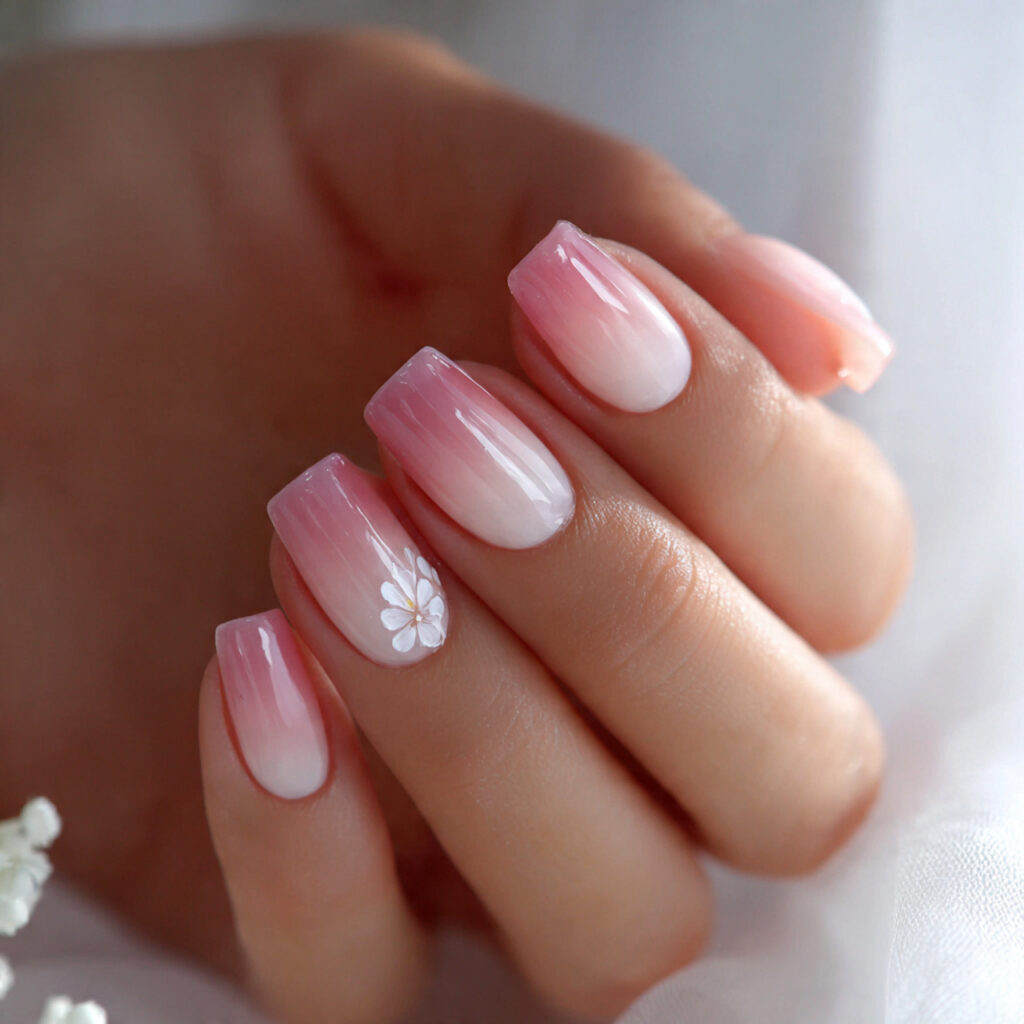
11. Pastel Gradient With Floral Accent
Why It Works
A soft ombré base with a small, delicate flower painted on one or two accent nails combines the softness of transition nails with the femininity of floral nail art. The gradient does the heavy lifting visually, and the flowers add a personal, handcrafted touch that makes the whole set feel special.
How to Do It
Complete your gradient first on all ten nails and let it dry completely. Then use a fine nail art brush to paint tiny blossoms, five-petal simple flowers in white or a slightly deeper shade from the gradient palette, on the ring finger nails.
Insider Tip
Flowers in a white or pearl shade over a pastel gradient look more elevated than flowers in a contrasting color. The tonal quality keeps everything feeling cohesive rather than busy.
12. Marble Pastel Transition

Why It Works
Soft marble veining over a pastel gradient base creates a look that’s both artistic and deeply elegant. The marble effect adds movement and organic texture to the color blend, like the gradient is a natural stone formation rather than a painted nail.
How to Do It
Complete the pastel gradient base first. Using a thin nail art brush or a thin piece of plastic wrap, drag a slightly darker version of one of the gradient shades in thin, branching lines across the surface. The lines should be irregular and organic, marble veins are never perfectly straight.
Common Mistake
Making the veining too dark or too defined. In pastel marble, the veins should be soft, just a shade or two deeper than the background, so they read as shadow and texture rather than bold contrast.
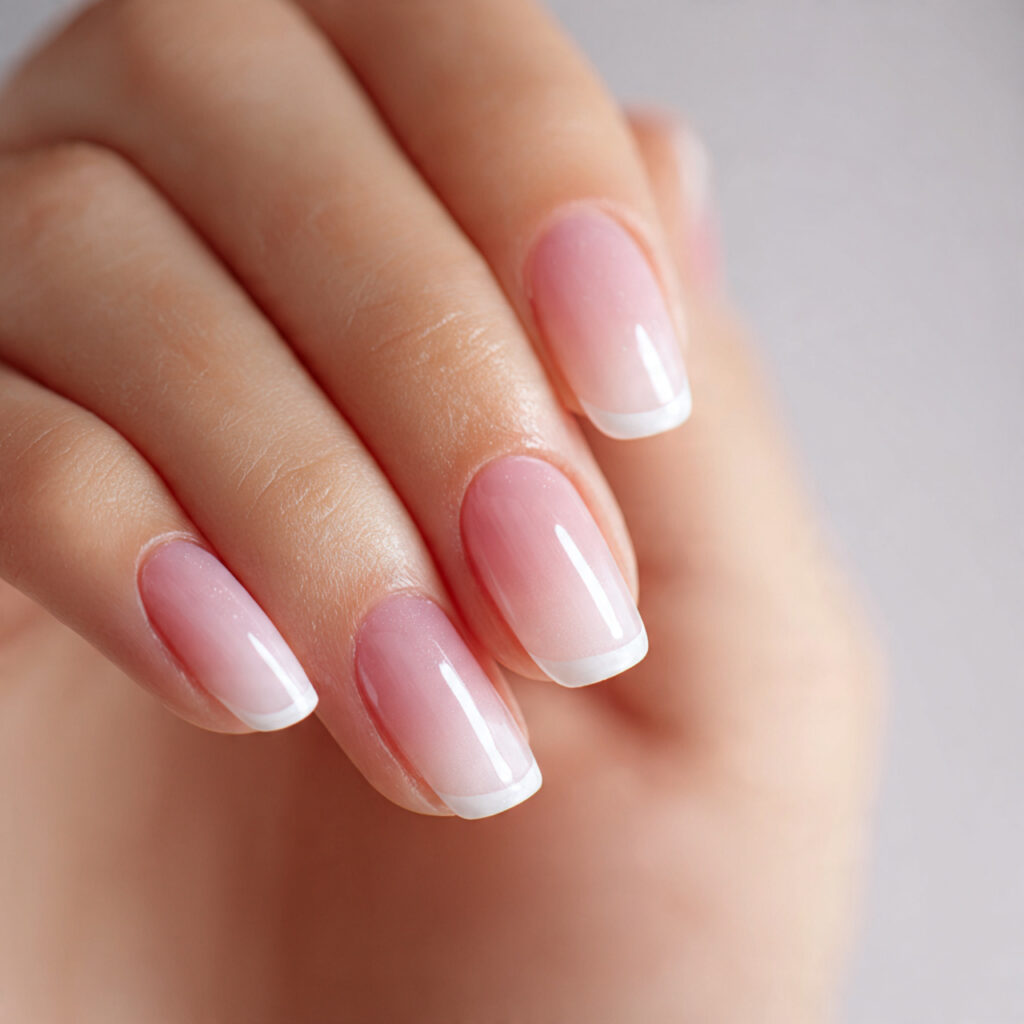
13. Pastel French With Ombré Base
Why It Works
A pastel gradient base with a delicate white or pearl French tip is the most elegant version of this aesthetic. The ombré underneath adds depth and color, and the French tip adds precision and a polished finish. It has a romantic, high-end quality that works for everything from casual days to formal occasions.
How to Do It
Create your gradient base as usual. Once completely dry, apply French tip tape in a curved or straight line near the nail tip and paint the tip in milky white or soft pearl. Remove tape carefully and seal with high gloss.
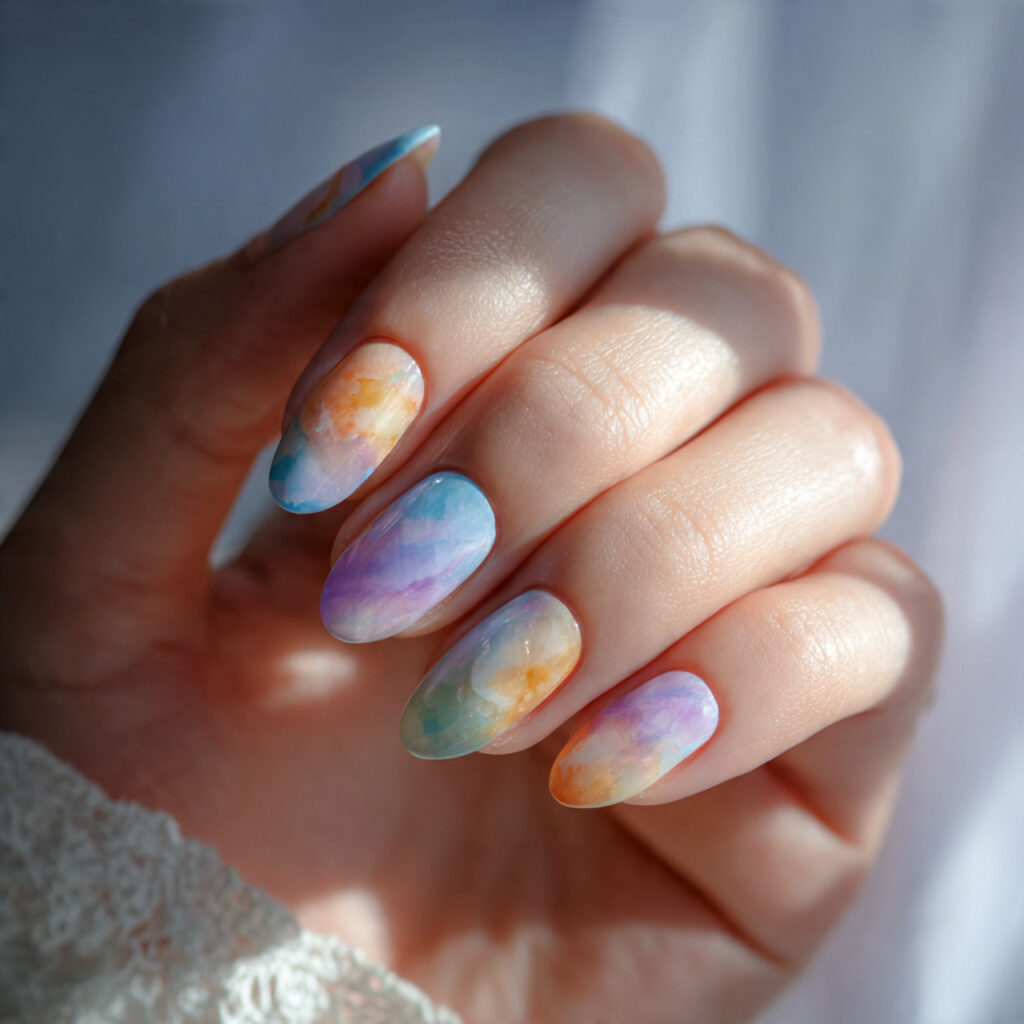
14. Watercolor Pastel Wash
Why It Works
Rather than a clean, structured gradient, a watercolor wash nail is intentionally soft and slightly blurred, like color applied to wet paper. Multiple pastels overlap and bleed into each other in a loose, organic way that looks genuinely artistic.
How to Do It
Apply a thin coat of clear base. While still slightly tacky, dab two or three pastel shades onto the nail using a sponge or your fingertip, letting them overlap loosely. Don’t blend methodically, the organic randomness is the point. Seal with a glossy top coat.
Insider Tip
Keep the color coverage light rather than opaque for this technique. The sheer, translucent quality is what makes it look like watercolor rather than just messy polish application.
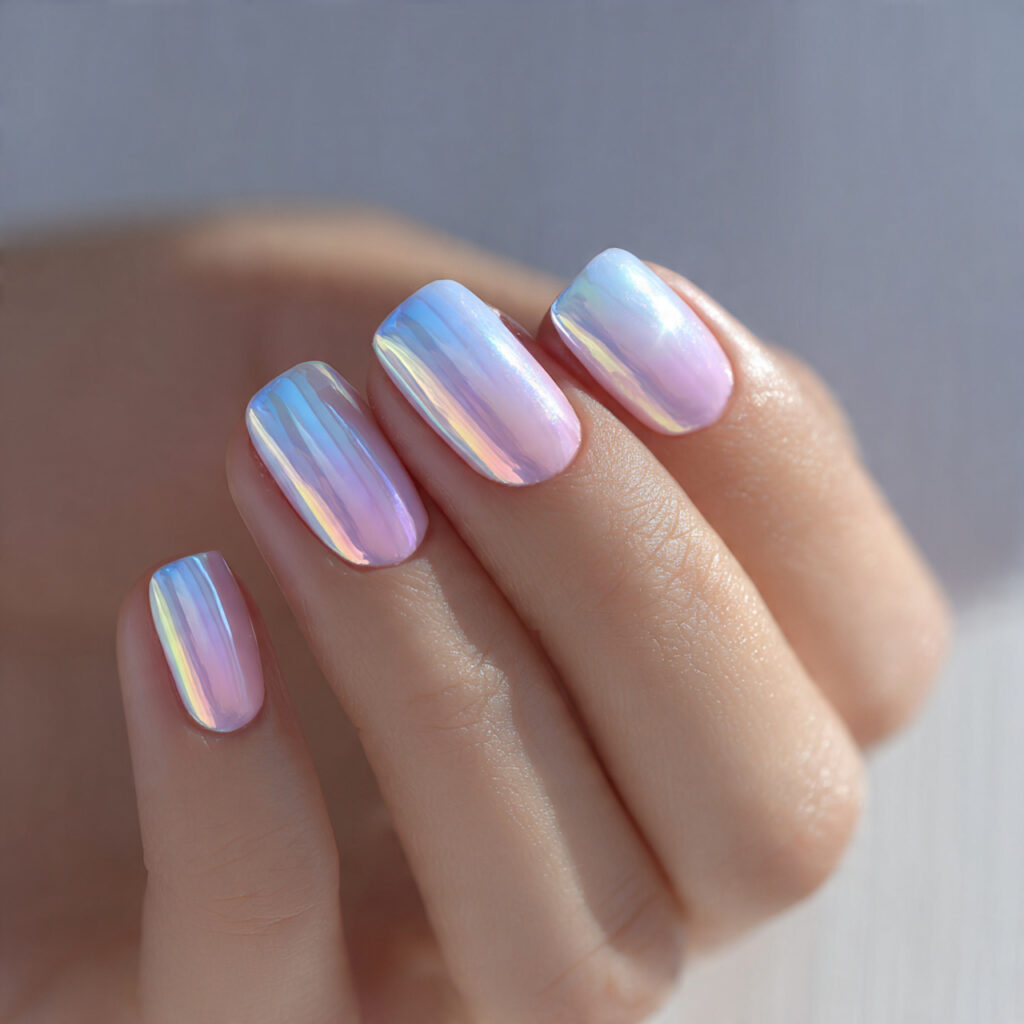
15. Pastel Chrome Gradient
Why It Works
Chrome powder in pastel tones, pale pink chrome, mint chrome, lilac chrome, applied over a gradient base creates a look that’s simultaneously soft and futuristic. The reflective quality of chrome amplifies the color shift of the gradient underneath, making every movement of your hand catch light differently.
How to Do It
This works best in gel, but at home, applying a chrome nail powder over a tacky gel-like top coat achieves a similar effect. Use different chrome shades over each section of the gradient for a multi-tonal chrome effect.
16. Pastel Negative Space Gradient

Why It Works
Negative space nail art, where sections of the natural nail are left bare intentionally, brings a modern, editorial quality to pastel transitions. The gradient appears in specific zones of the nail while the rest remains clear or lightly frosted.
How to Do It
Use nail tape to mask off sections of the nail, a diagonal strip, a half-moon at the base, or a geometric shape near the tip. Apply your gradient to the unmasked area. Remove tape carefully while polish is still slightly wet. Seal with gloss.
Common Mistake
Using tape on polish that’s too wet or too dry. Too wet and the tape pulls the polish. Too dry and the tape creates a ridge. Aim for the tacky-but-set stage, usually around two minutes after application.
17. Sunset Pastel Set
Why It Works
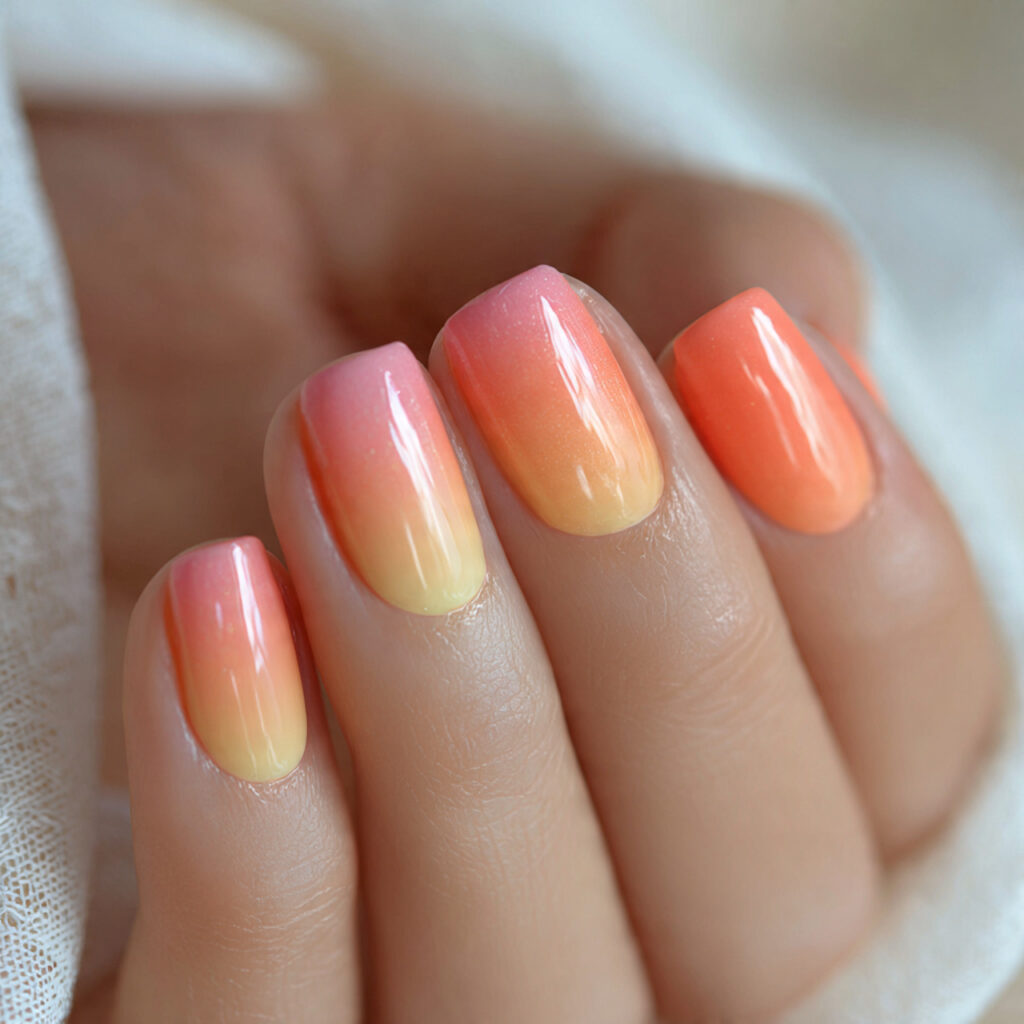
Coral at the base of the nail fades to peach, then pale yellow at the tip, mimicking the exact palette of a sunset sky. It’s one of those nail looks that makes people say “oh, those are beautiful” without entirely being able to explain why. The answer is that sunset colors live in our emotional memory as inherently beautiful, and wearing them activates that feeling.
How to Do It
Three-shade sponge gradient moving vertically from coral base through peach to yellow-cream at the tip. All three should stay firmly in the warm pastel family, if coral creeps too red or yellow creeps too bright, the sunset effect is lost.
18. Aurora Pastel Nails
Why It Works
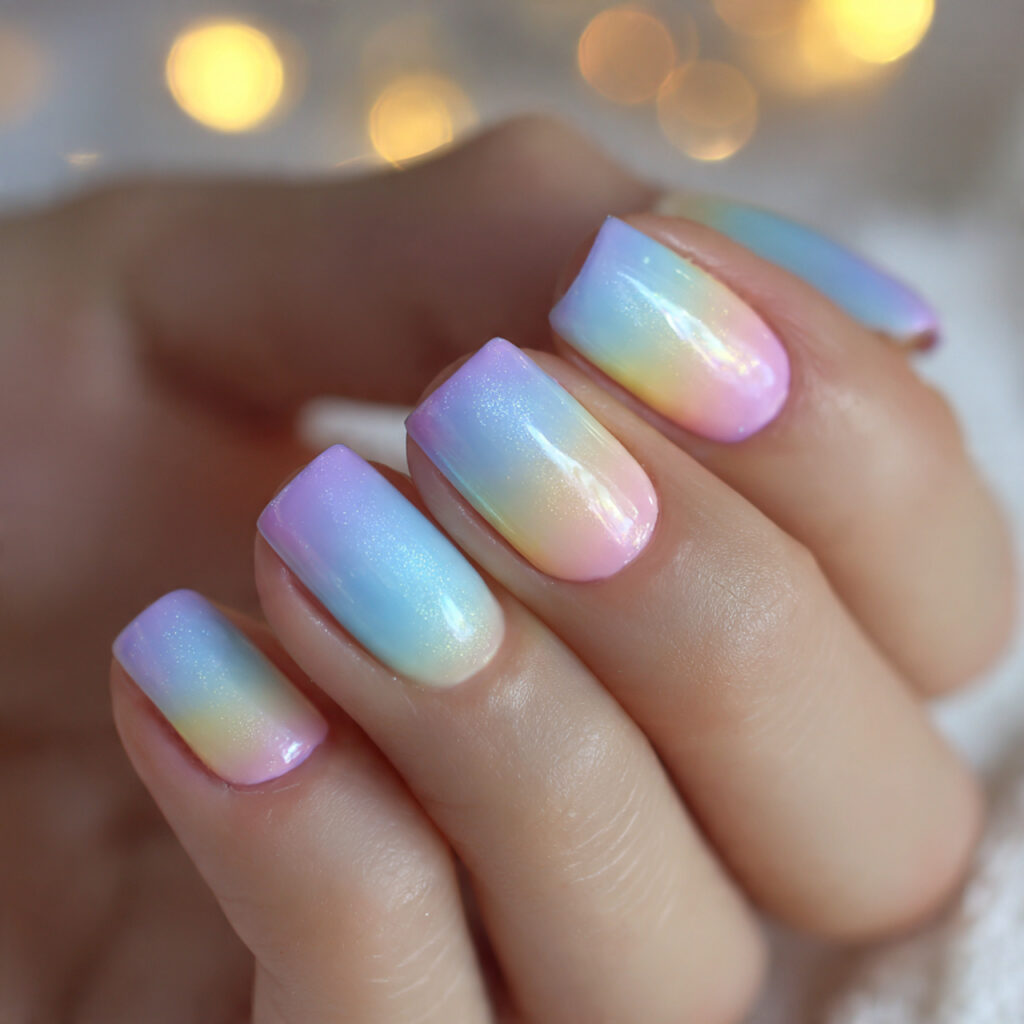
Aurora nails are inspired by the northern lights, shifting, iridescent color that seems to move and change. In pastel form, this means a gradient base in cool pastels (mint, periwinkle, lavender) finished with a strong iridescent or holographic top coat that adds an otherworldly shimmer to the color blend.
How to Do It
Apply a cool pastel gradient as your base. Finish with two coats of aurora or holo top coat, these are widely available in both gel and regular formula now. The iridescence reads differently under every light source, which makes these nails endlessly interesting to look at.
19. Pastel Galaxy Gradient

Why It Works
Galaxy nails sound dramatic, but a pastel galaxy is soft and dreamlike rather than bold. A dark blue or purple base is left out entirely, instead, lavender, periwinkle, soft teal, and dusty pink blend together in a loose, cosmic way that hints at stars and space without going dark.
How to Do It
Use the dabbing technique with a makeup sponge, applying three to four pastel cool shades in overlapping sections. Add tiny dots of white over the top once dry to suggest stars. Finish with a holographic or fine glitter top coat for the final cosmic touch.
20. Tie-Dye Pastel Nails

Why It Works
Tie-dye nail art uses swirling, circular color application to create an organic, almost psychedelic blend that looks completely different from a standard gradient. In pastel shades, the tie-dye effect looks whimsical and playful rather than overwhelming.
How to Do It
The water marble technique works well here: drop pastel polishes one at a time into a small cup of room-temperature water, swirl with a toothpick, and dip your nail through the surface. The colors adhere to the nail in a swirled pattern. It takes practice but the results are unlike anything else.
Insider Tip
Work quickly with water marble, polish on water starts to dry fast. Have everything prepped before you open the bottles. And coat the skin around your nail with Vaseline or liquid latex first for much easier cleanup.
The next section covers the more advanced and creative transition ideas, including some that are genuinely show-stopping. Don’t skip ahead just yet.
Advanced and Show-Stopping Pastel Transition Looks
These ideas push the aesthetic further, more complex, more artistic, more you.
21. Pastel Geometric Gradient
Why It Works
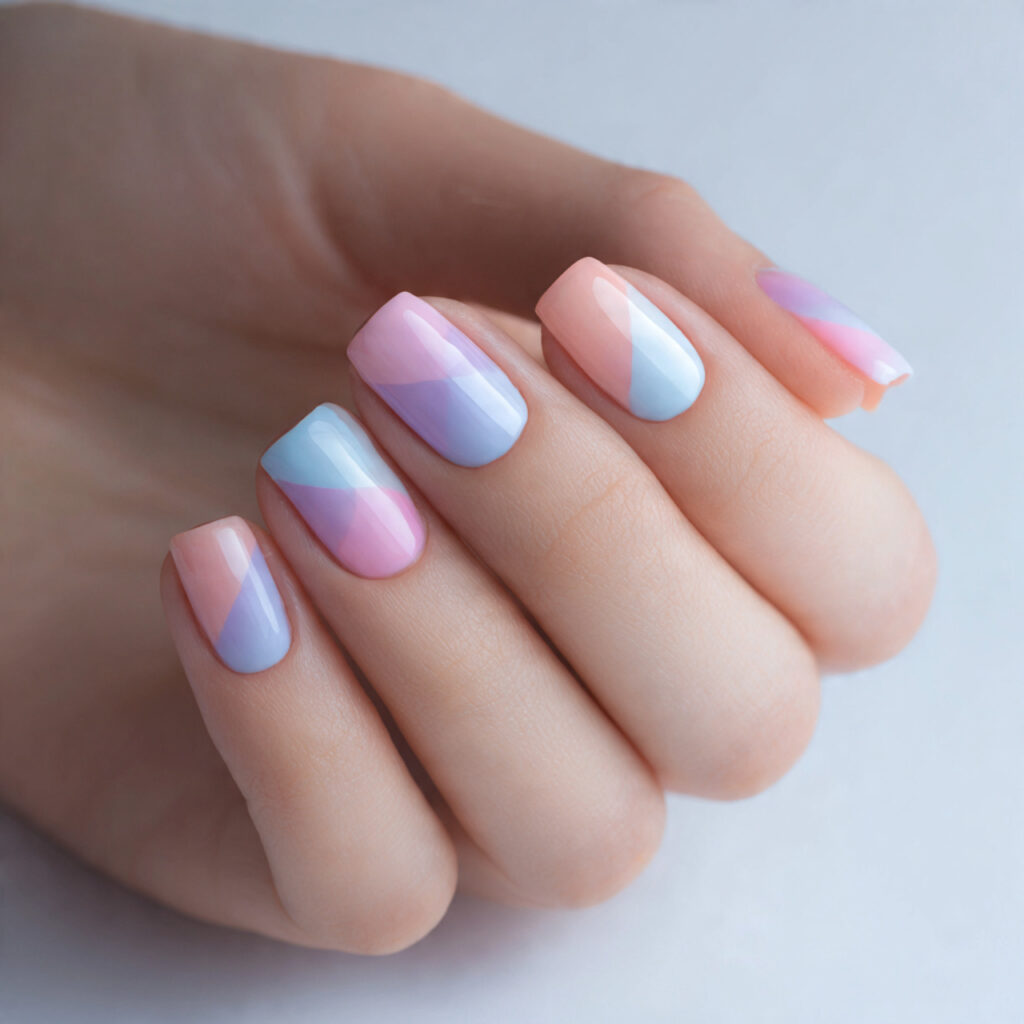
Clean geometric lines, triangles, diamonds, half-moons, filled with gradient color create a look that’s simultaneously precise and dreamy. The structure of geometry and the softness of pastels create a contrast that feels genuinely sophisticated.
How to Do It
Use nail tape in geometric arrangements on the nail surface. Apply gradient color within the taped zones. Remove tape carefully. The clean edges of the geometric shapes against soft pastel blends create a look that looks professionally done.
22. Pastel Color-Block With Soft Blended Edge

Why It Works
Color blocking, distinct zones of different colors, is typically a bold, high-contrast look. In pastels with deliberately blended edges rather than hard lines, it becomes something softer and more artistic. Two or three pastel zones on one nail, each bleeding slightly into the next.
How to Do It
Apply the first pastel in the lower third of the nail. Apply the second in the middle third. Apply the third in the upper third. While all are still wet, use a clean fine brush to very gently stroke the boundaries between zones, softening the edges just enough to blur without fully blending.
23. Foil Pastel Transition
Why It Works
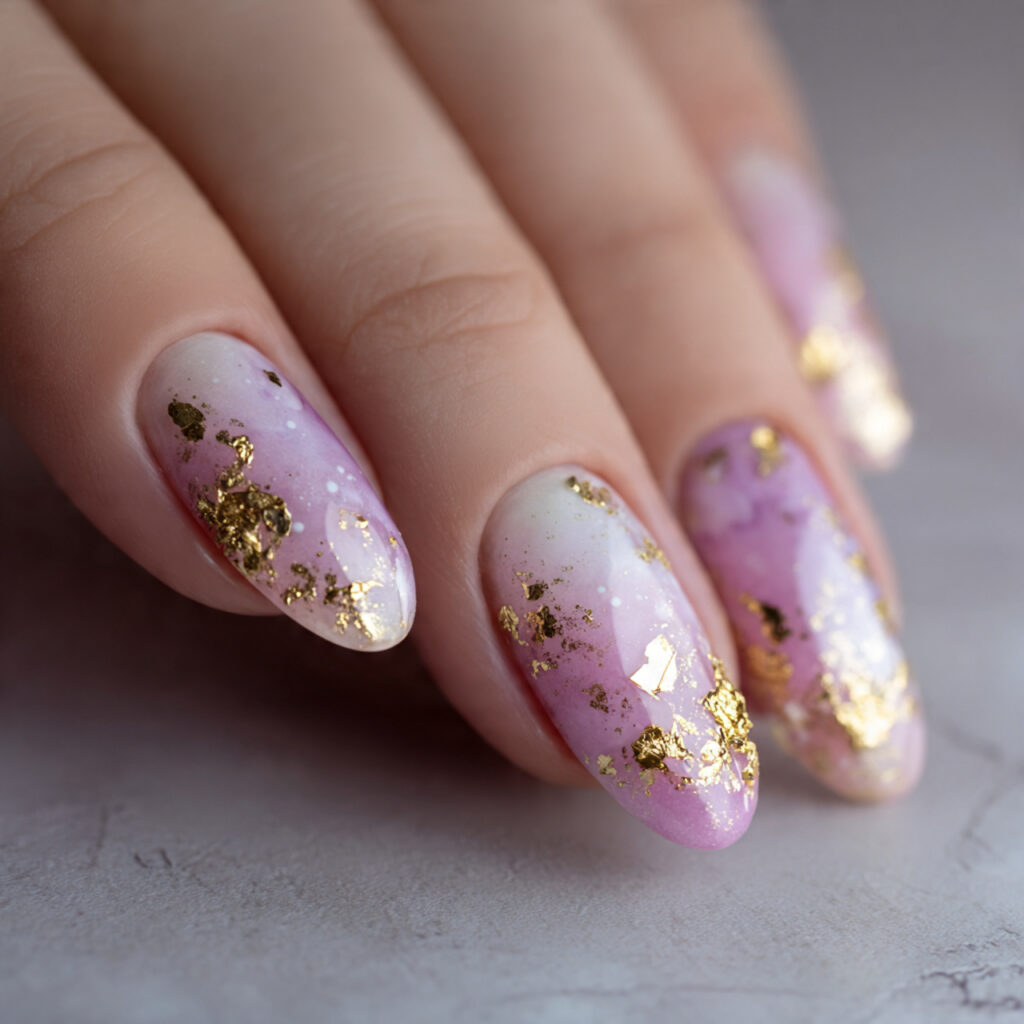
Gold or rose gold foil pieces applied sporadically over a pastel gradient add a luxe, editorial quality. The foil catches light differently from the pastel underneath, creating a layered, multidimensional effect that reads as genuinely artistic.
How to Do It
Complete your gradient base. Apply small torn pieces of gold foil over a tacky top coat layer, pressing firmly and peeling back. Seal with high gloss. The torn-edge quality of the foil pieces looks intentionally textured rather than accidental.
24. Shimmer Dust Pastel Gradient
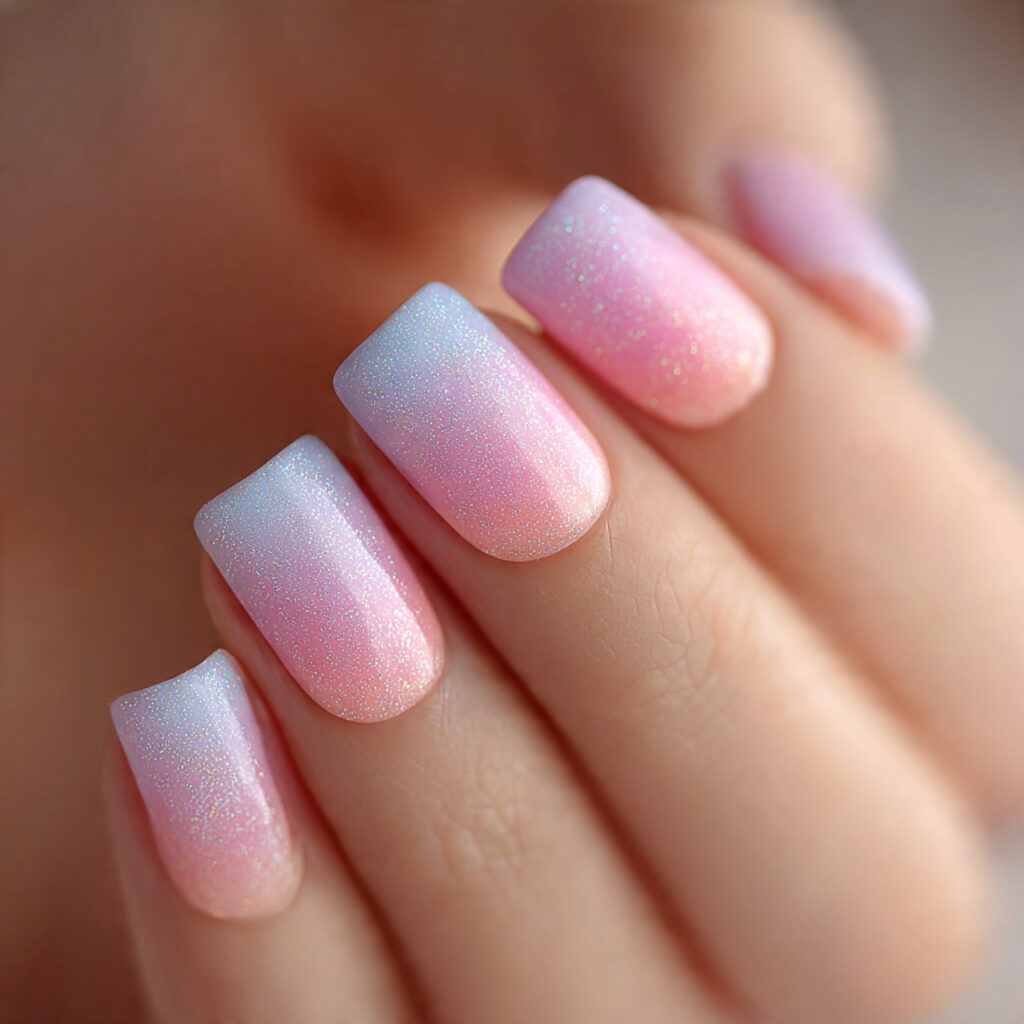
Why It Works
A fine, iridescent shimmer powder, dusted over a pastel gradient while the top coat is still tacky, creates a look that’s between a chrome and a glitter. It catches light like neither but is more beautiful than both. The shimmer sits within the gradient rather than on top of it, making the whole nail glow.
25. Pastel Ombré Press-Ons for Beginners
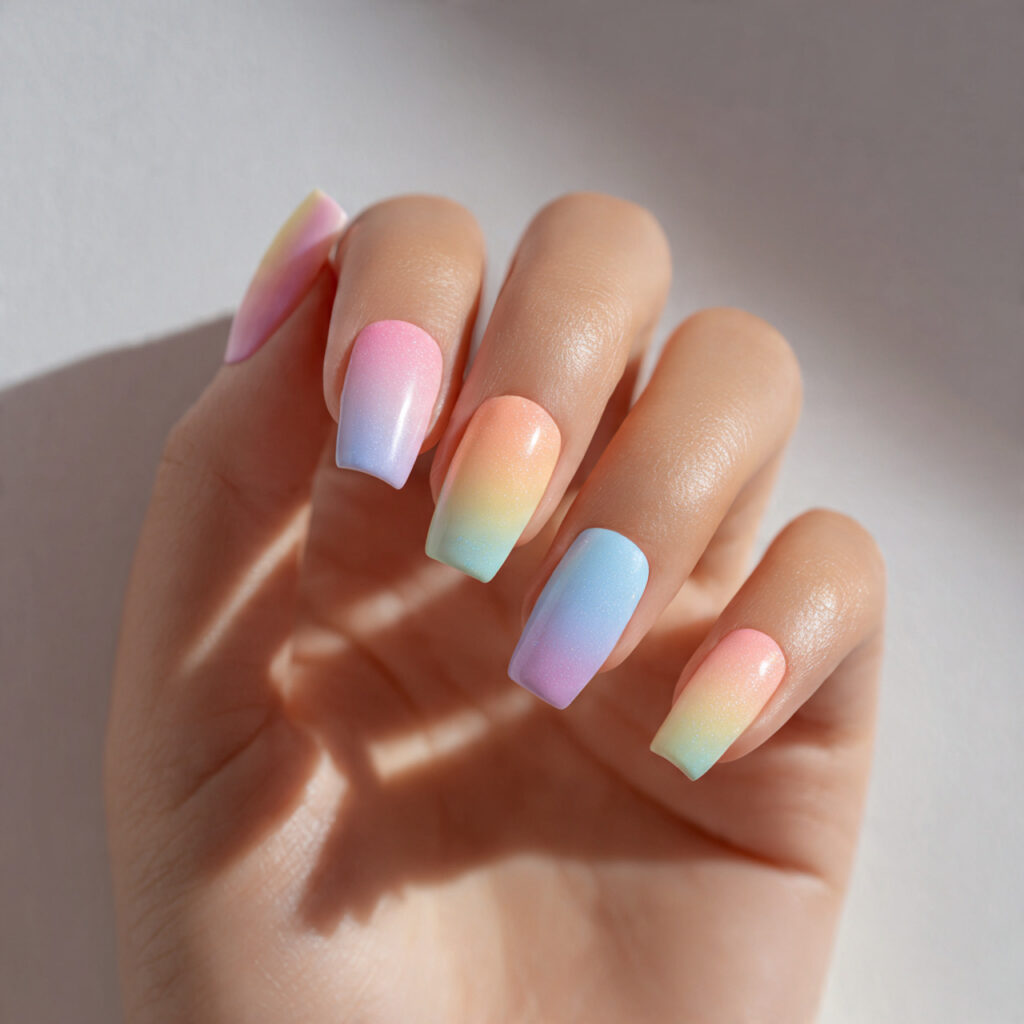
Why It Works
Not everyone wants to do the sponge gradient technique at home, and that’s completely fine. High-quality press-on nails in pastel gradient designs have improved dramatically. They look genuinely beautiful, last up to two weeks with good preparation, and come in every pastel combination imaginable.
Insider Tip
Prep your natural nails by buffing and cleaning with alcohol before applying press-ons. The adhesion is dramatically better on a clean, slightly roughed surface. Apply from the cuticle edge first, pressing firmly down toward the tip.
26. Pastel Dip Powder Gradient
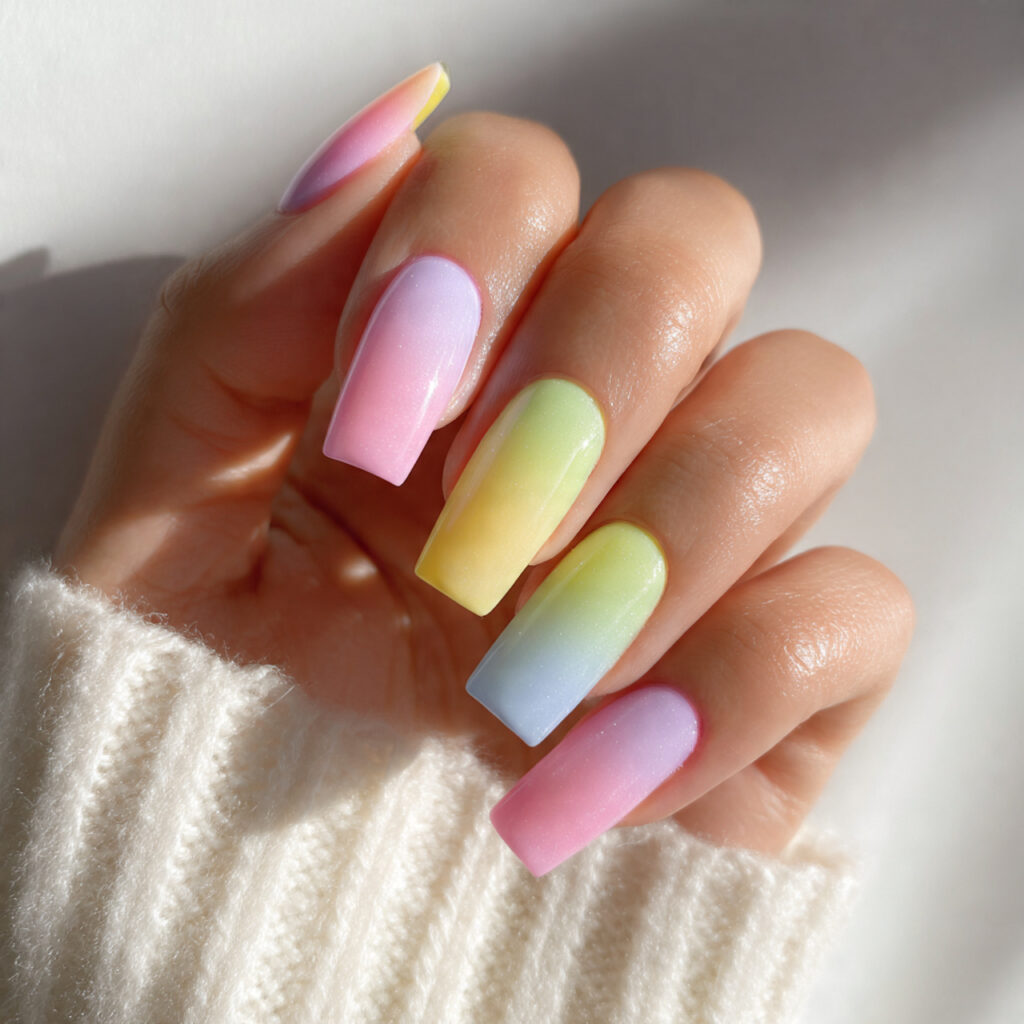
Why It Works
Dip powder creates a stronger, longer-lasting gradient than regular polish, and in pastel shades, the finish is smooth, even, and deeply pigmented in a way that gel and regular polish sometimes struggle to achieve.
How to Do It
Dip one section of the nail into the first pastel color, then dip the adjacent section into the second, overlapping slightly in the center. The dip process naturally creates some blending at the boundary. Seal with activator and top coat as usual.
27. Pastel Jelly Gradient

Why It Works
Jelly polishes, sheer, translucent, gel-like, create gradients with a distinctly different quality from opaque shades. The sheerness means multiple layers build depth gradually, and the final effect looks almost like stained glass: colorful, luminous, and delicate.
How to Do It
Apply three to four thin coats, concentrating more coats of the deeper shade in the base zone and fewer coats near the tip. The translucency of jelly polish means each layer adds color without obscuring the ones beneath, the gradient builds itself slowly and beautifully.
28. Pastel Mirror Ombré
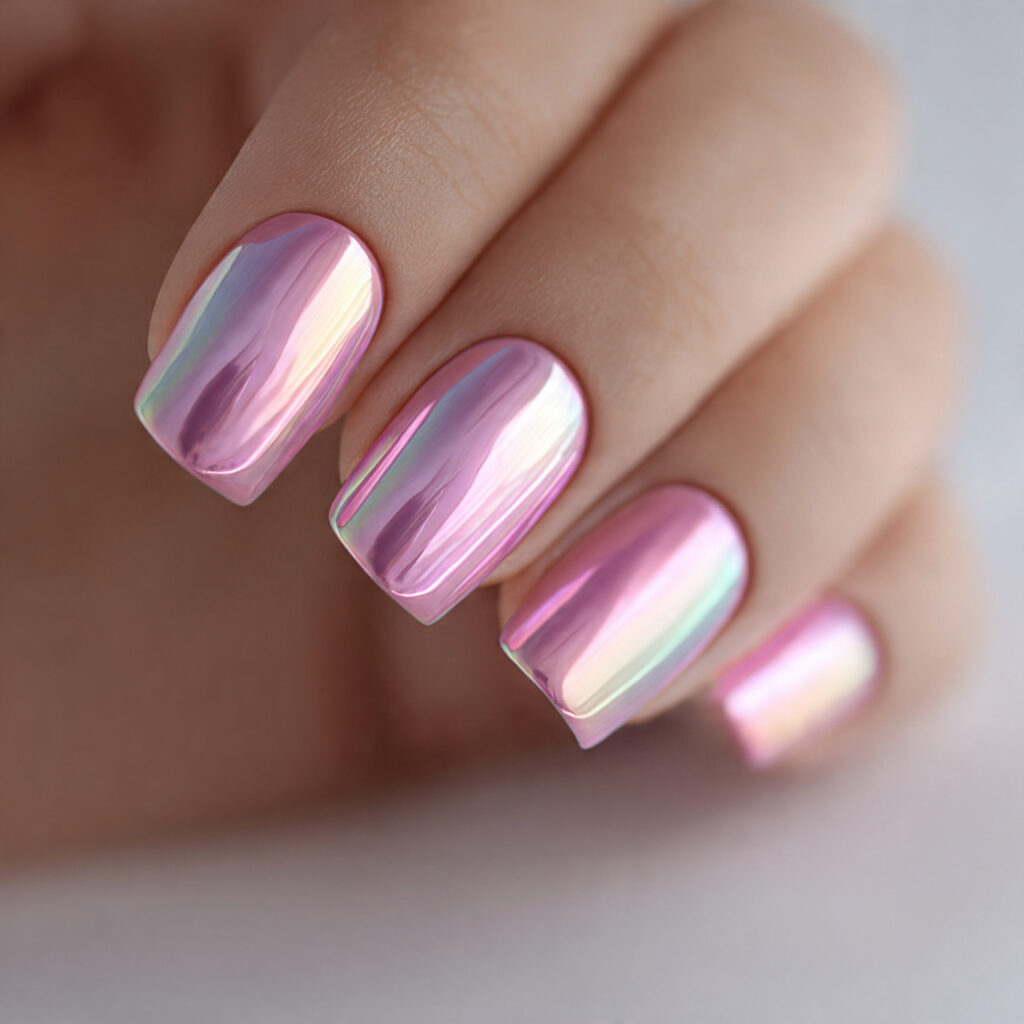
Why It Works
Mirror chrome applied in gradient form, more coverage at the base fading to less at the tip, or in two different chrome pastel shades blending at the center, creates a look that’s simultaneously soft and high-impact. It’s the most advanced look in this guide and one of the most stunning.
How to Do It
Apply chrome powder more heavily in the base zone and dust gradually lighter toward the tip. Or use two chrome powders, pink chrome and blue chrome, for example, meeting in the center and dusted gently until they melt into each other.
29. Full Hand Pastel Spectrum With Accent Art
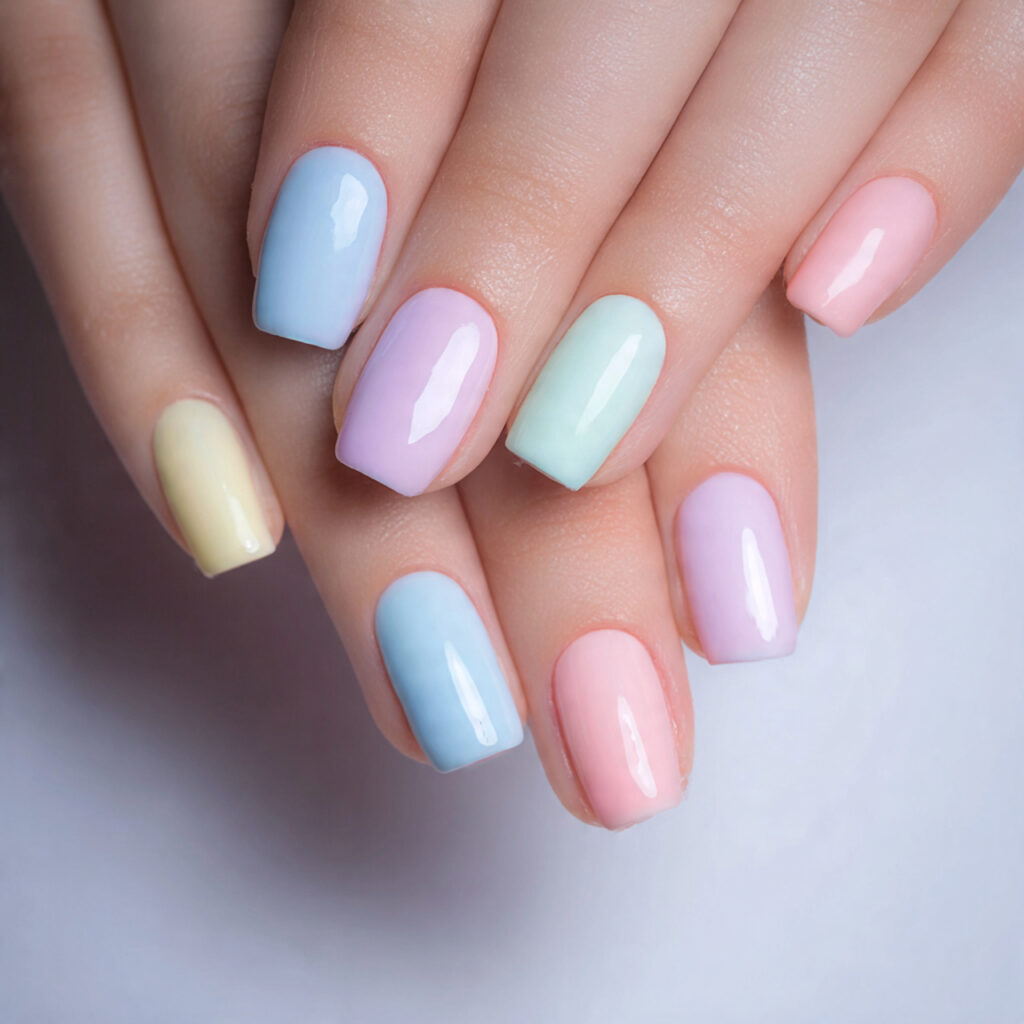
The Look
Each nail on both hands moves through the full pastel spectrum, coral, peach, yellow, mint, sky blue, periwinkle, lavender, blush, with a single delicate detail added to the ring finger nails: a tiny pearl, a micro flower, or a fine gold line. The spectrum provides the show. The accent provides the signature.
Why It’s the Ultimate Pastel Transition Look
This is the look that brings together everything the pastel transition aesthetic stands for: color, softness, intentionality, and just enough personal detail to feel uniquely yours. It’s the kind of nail set that stops conversations and makes people reach across a table to look more closely.
How to Wear It
There’s no wrong occasion for this look. It’s joyful enough for a celebration, soft enough for an ordinary Tuesday, and beautiful enough to feel like a treat every single time you look down at your hands.
The Techniques That Make Every Gradient Better
Regardless of which look you choose, these core techniques make the difference between a gradient that looks homemade and one that looks intentional.
The Sponge Method Your Most Important Tool
A small, fine-textured makeup sponge is the foundation of most nail gradient techniques. Paint your two (or three) shades in overlapping bands on the sponge, then dab onto the nail with a gentle patting motion rather than a sweeping one. Sweeping drags the colors; patting blends them. Build up four to six layers of sponge application for a smooth, even result.
The Sheer Base Rule
Most pastel gradients look better over a sheer white or milky base than directly on the natural nail. The light base gives the pastels something bright to reflect against, making the colors more vivid and the transition more visible. Apply and let dry fully before sponging your gradient on top.
Cleanup Is Part of the Look
Gradient techniques create mess around the nail edges, it’s inevitable. A thin brush dipped in acetone, traced carefully around the cuticle and side walls after everything dries, is what transforms a messy-looking gradient into a clean, professional result. Never skip this step.
The Double Gloss Finish
Apply one coat of glossy top coat, let it dry, then apply a second coat. The second coat fills any remaining texture from the sponge application and creates that smooth, glass-like finish that makes pastel gradients look truly polished. Two coats of gloss is the industry secret most people miss.
Common Mistakes to Avoid With Pastel Transition Nails
Even with the right technique, a few habits can undermine a beautiful gradient.
Choosing colors that are too similar in tone is the most common issue. If both shades are equally light and pale, the gradient disappears and the nail just looks like one color. You need enough tonal difference between your two shades for the transition to be visible.
Working too slowly is the second. Pastel polishes dry quickly, especially in thin layers. If you take too long between sponge applications, the layers stop blending and start layering over each other in a way that creates texture rather than gradient. Work at a steady, moderately paced rhythm.
Skipping base coat undermines the color payoff. Pastels especially benefit from a white or opaque base because their pigmentation is naturally soft. On a bare or natural nail, many pastels look patchy. On a proper base, they look vivid and even.
And not sealing with gloss at the end, in pastel transition nails, the top coat isn’t optional. It’s structural. It smooths the texture, unifies the look, and gives the gradient its luminous, finished quality. Always seal. Always gloss.
Pastel Transition Nails Are Pure Joy on Your Fingertips
Here’s the most honest thing about pastel transition nails: they make people happy. Not just the people wearing them, the people who see them. There’s something about soft, blended color that feels genuinely uplifting. Hopeful. Like spring arriving or a sunrise happening or a garden just after rain.
That’s not a small thing. Beauty that improves your mood and the mood of everyone around you, that matters.
Whether you go with a simple lavender-to-blush gradient on short oval nails or a full hand pastel spectrum with pearl accents on long coffin nails, the result is the same: nails that look like you put thought and care into how you show up in the world. Because you did.
Start with the idea that made you feel something when you first read it. Try the technique once, imperfectly, and then again better. Let yourself experiment with color combinations. Let yourself be the person with nails that make people say oh, I love those before you’ve even sat down.
Because some things in life are complicated. Your nails getting to be beautiful doesn’t have to be one of them.
The most stunning gradient is the one you finally decide to try.